
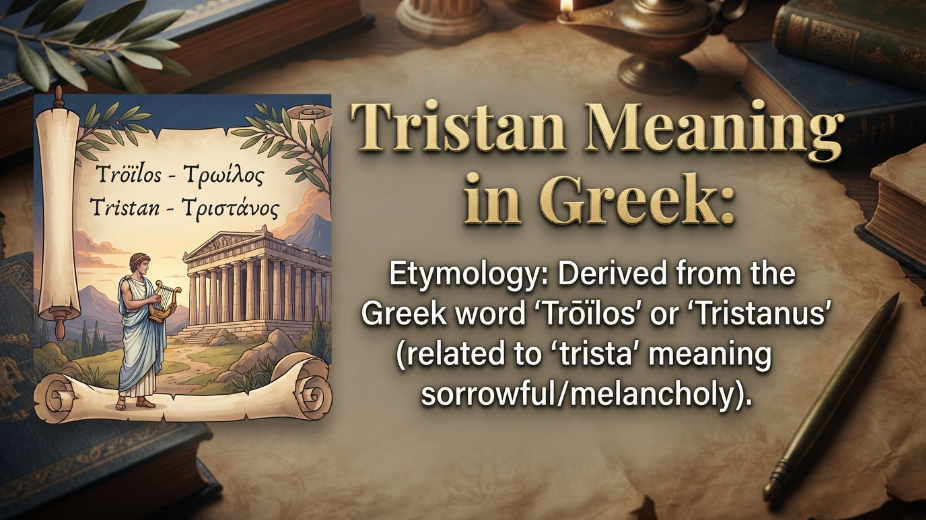
Have you ever held your newborn child and whispered a name over them, wondering what it means — whether it carries something sacred, something that might shape who they become? Or perhaps you’re someone who has carried the name Tristan your whole life and suddenly find yourself asking a deeper question: Does my name mean anything to God? Does it reflect something true about who I am?
Names matter profoundly in Scripture. In the Bible, a name was never merely a label — it was a declaration of identity, destiny, and character. When God changed Abram to Abraham, or Jacob to Israel, He wasn’t just updating a legal record. He was speaking a new reality into existence. He was saying, I know you. I see you. And I’m calling you into something greater.
So when Christians, parents, or curious believers search for the meaning of a name like Tristan — particularly its Greek roots and any biblical connection — they’re doing something deeply human and spiritually instinctive. They’re asking: What does this name say about the soul that carries it?
This article will take you on a thorough journey through the Greek and Celtic linguistic origins of the name Tristan, its spiritual and thematic resonance with biblical truth, the scriptural principles that relate to its core meaning, and what all of this can mean for your faith today. Whether you’re naming a child, exploring your own identity in Christ, or simply curious about the intersection of language, history, and Scripture, you will find rich, biblical, and practical encouragement here.
Quick Answer: What Does Tristan Mean in Greek?
The name Tristan does not originate directly from the Greek language — it is primarily a name of Celtic origin, derived from the Pictish or Old Welsh name Drust or Drustan, meaning “noise,” “tumult,” or “din.” Over time, particularly through Norman French influence, it evolved into the familiar form Tristan.
However, the name became strongly associated with the Latin word tristis, meaning “sad” or “sorrowful,” particularly through the medieval legend of Tristan and Isolde. This Latin-sorrowful connection is sometimes mistakenly presented as the name’s primary meaning.
In Greek, the closest semantic equivalents to Tristan’s meanings are:
- θόρυβος (thorybos) — noise, tumult, uproar
- λύπη (lypē) — grief, sorrow, pain
While Tristan is not a biblical name per se, its meanings — particularly sorrow and tumult — are deeply woven throughout Scripture. The Bible speaks extensively about both realities, offering profound hope, redemption, and divine purpose within them. God does not shy away from sorrow or noise; He meets us in the midst of both.
The Etymology of Tristan: Greek, Latin, and Celtic Roots
The Celtic Origin: Drust and Drustan
The name Tristan traces its earliest roots to the Pictish name Drust, attested in early medieval Scottish and Welsh records. The Picts were a people of ancient Britain, and names like Drust and Drustan appear in their king lists. The Proto-Celtic root likely connects to words meaning noise or tumult — a fitting name for a warrior culture that valued strength and ferocity in battle.
The name Drustan eventually entered Norman French as Tristran and then Tristan, spreading across Europe through Arthurian and medieval romance literature.
The Latin Confusion: Tristis and Sorrow
When the medieval legend of Tristan and Isolde swept through European literature — told by poets like Béroul and Gottfried von Strassburg — storytellers drew a folk-etymological connection between the name Tristan and the Latin tristis, meaning “sad” or “sorrowful.” This wasn’t linguistically accurate, but it was narratively powerful. The character Tristan was indeed sorrowful — torn between love and loyalty, caught in tragedy and longing.
As a result, the “sorrowful” meaning became culturally dominant, and it is the meaning most people encounter today.
The Greek Semantic Field
While Greek is not the direct linguistic ancestor of Tristan, understanding the Greek words that parallel its meanings gives us access to a rich biblical vocabulary:
- λύπη (lypē) — the Greek word for sorrow, grief, or sadness. This word appears throughout the New Testament, including in 2 Corinthians 7:10, where Paul distinguishes between godly sorrow and worldly sorrow.
- θόρυβος (thorybos) — meaning noise, uproar, or confusion. It appears in Acts 21:34 and other passages describing tumult and disorder.
- ταραχή (tarachē) — disturbance, trouble, agitation — another Greek word capturing the “tumult” aspect of Tristan’s Celtic roots.
These Greek words open a biblical doorway. Sorrow and tumult, far from being spiritually meaningless experiences, are the very terrain where God most powerfully reveals His character.
What the Bible Says About the Themes Behind the Name Tristan
The two core meanings of Tristan — sorrow and tumult/noise — appear throughout the Bible with remarkable depth. Scripture does not sanitize these realities; instead, it redeems them. Below, we explore what God’s Word says about both themes, organized into meaningful categories.
Part One: The Biblical Meaning of Sorrow (Lypē)
Category 1 — Sorrow Acknowledged and Held by God
Psalm 34:18 — “The Lord is close to the brokenhearted and saves those who are crushed in spirit.”
David wrote this psalm after a desperate, humbling experience. He had feigned madness before a Philistine king to save his own life — hardly a glorious moment. Yet from that low place, he penned one of Scripture’s most comforting promises. God does not distance Himself from sorrow; He draws near to it.
Application: If you or someone you love carries a name meaning sorrow, or if you are walking through a season of grief, this verse is God’s personal address to you. He is not watching your pain from a distance. He is close — present in the places of breaking.
Reflection: In an age where we are told to project strength and suppress vulnerability, this verse is radically countercultural. The crushed spirit is not a sign of spiritual failure. It is an invitation for divine nearness.
John 11:35 — “Jesus wept.”
The shortest verse in the Bible carries extraordinary theological weight. When Jesus arrived at the tomb of Lazarus — knowing full well He was about to raise him from the dead — He still wept. He entered into the grief of Mary and Martha before He displayed His power.
Application: Jesus does not bypass your sorrow on the way to your miracle. He sits in it with you first. This is the heart of a God who understands lypē from the inside.
Reflection: For anyone named Tristan — or carrying a season of deep grief — Jesus’ tears at Lazarus’ tomb are a reminder that your sorrow is not weakness. It is witnessed, and it is shared by the Son of God.
Category 2 — Sorrow That Produces Growth
2 Corinthians 7:10 — “Godly sorrow brings repentance that leads to salvation and leaves no regret, but worldly sorrow brings death.”
Paul makes a profound distinction here that is essential to biblical understanding. Not all sorrow is the same. Godly sorrow (lypē kata theon — sorrow according to God) is the kind that leads somewhere — toward transformation, repentance, and deeper life. Worldly sorrow, by contrast, turns inward, produces guilt without grace, and leads to spiritual death.
Application: When sorrow visits your life, ask God to transform it into godly sorrow — the kind that refines rather than destroys. The name Tristan, connected to sadness, can be seen not as a burden but as a reminder that God can make meaning from mourning.
Reflection: This verse revolutionizes how we view painful seasons. They are not punishments. They are potential turning points toward something more real, more free, and more aligned with God’s purposes.
Psalm 30:5 — “Weeping may stay for the night, but rejoicing comes in the morning.”
This is one of Scripture’s most beloved promises about sorrow’s temporality. The Hebrew word for weeping here — bekhi — carries weight. It is authentic, deep mourning. And yet the Psalmist is unafraid to hold it alongside the certainty of morning.
Application: If your night has been long — if sorrow has seemed permanent — this verse speaks directly to your situation. God is not indifferent to the duration of your pain. But He is also not finished writing the story.
Reflection: The Christian life is not the absence of weeping. It is the confidence that morning is coming — guaranteed by the resurrection of Jesus Christ.
Category 3 — The Comfort Within Sorrow
Matthew 5:4 — “Blessed are those who mourn, for they will be comforted.”
In the Sermon on the Mount, Jesus lists mourning as a beatitude — a state of blessedness. This is astonishing. How can mourning be blessed? Because Jesus promises it will not be wasted. Those who mourn will be comforted — not merely consoled, but filled with the paraklesis (the coming alongside) of God Himself.
Application: If your name is Tristan or if you are in a season of mourning, Jesus looks at you and says, “You are blessed.” Not because the grief is good, but because God is already moving toward you with comfort.
Reflection: The Beatitudes flip the world’s value system upside down. Sorrow, in God’s economy, is not a disqualifier — it is a doorway.
Isaiah 61:3 — “…to bestow on them a crown of beauty instead of ashes, the oil of joy instead of mourning, and a garment of praise instead of a spirit of despair.”
This is the great exchange passage — the prophetic declaration that Jesus quoted in Luke 4:18 when He announced His own ministry. God promises to trade beauty for ashes, joy for mourning, praise for despair. Every element is a redemptive inversion of sorrow.
Application: The name Tristan may carry “sorrow” in its heritage, but this verse is God’s response to sorrow: I am making exchanges. Nothing you bring to Him stays in its original, broken form.
Reflection: This is the gospel at its most tangible. God takes what is ruined and makes it radiant. Sorrow does not have the final word.
Part Two: The Biblical Meaning of Tumult and Noise (Thorybos)
Category 4 — God’s Peace in the Midst of Tumult
John 16:33 — “I have told you these things, so that in me you may have peace. In this world you will have trouble. But take heart! I have overcome the world.”
Jesus spoke these words on the night of His betrayal — the most turbulent night of His earthly life. He did not promise an absence of trouble (the Greek word thlipsis — tribulation, pressure, distress). He promised that His peace could exist within it, because He had overcome the source of all ultimate chaos.
Application: The “tumult” meaning of Tristan does not have to describe your inner life, even when external circumstances are chaotic. The peace Jesus offers is not dependent on quiet surroundings — it is rooted in His victory.
Reflection: For those navigating noisy, turbulent seasons — in relationships, health, finances, or faith — this verse is an anchor. Not a promise that the noise stops, but that you are held by One who has already won.
Philippians 4:6-7 — “Do not be anxious about anything, but in every situation, by prayer and petition, with thanksgiving, present your requests to God. And the peace of God, which transcends all understanding, will guard your hearts and your minds in Christ Jesus.”
Paul wrote this from prison — a genuinely tumultuous circumstance. The peace he describes is not intellectual serenity. It is a supernatural guard (phrourēo in Greek — a military term for a garrison standing watch) placed over the heart and mind by God Himself.
Application: When life feels like thorybos — uproar and noise — prayer is the pathway to a peace that makes no logical sense but is absolutely real. This is not denial of chaos. It is the superimposition of divine order upon it.
Reflection: The “transcendence” of this peace is important. It will not always be explainable to others. People may not understand how you are calm in the storm. That’s because the peace is from God, not from circumstances.
Category 5 — God Commanding Peace Into Chaos
Mark 4:39 — “He got up, rebuked the wind and said to the waves, ‘Quiet! Be still!’ Then the wind died down and it was completely calm.”
The disciples were in genuine, life-threatening tumult — a violent storm on the Sea of Galilee. Jesus spoke three words (in Greek: Siōpa, pephimōso — “Be silent, be muzzled”) and the chaos obeyed. Immediately. Completely.
Application: Whatever tumult your life is experiencing, Jesus has authority over it. He is not overwhelmed by your storm. He has dominion over every form of noise and chaos.
Reflection: Notice that Jesus did not panic, strategize, or anxiously explain the storm to the disciples. He rebuked it. He has the same authority over every form of thorybos — every area of tumult — that you face.
Psalm 46:10 — “Be still, and know that I am God.”
The Hebrew word for “be still” here is raphah — to sink down, to let go, to cease striving. This is not passive resignation; it is the active, courageous act of releasing tumult into God’s hands and recognizing His sovereignty.
Application: In a world of constant noise — social media, anxiety, relentless demands — this ancient verse is a radical countercultural act. Stillness before God is how we remember who He is when everything around us is shouting.
Reflection: The full context of Psalm 46 is remarkable — nations are in uproar, kingdoms are falling, the earth is giving way. And in the middle of that, God says, “Be still.” His stillness-calling is not naïve. It is authoritative.
The Name Tristan Through a Biblical Lens: Redeemed Identity
One of the most powerful truths of the Christian faith is this: God redeems names. He redeems meanings. He redeems stories.
Abram (exalted father) became Abraham (father of many nations). Simon (he has heard) became Peter (the Rock). Saul (asked for) became Paul (humble, small). In each case, the transformation was not a rejection of what came before — it was a fulfillment and elevation of it.
If the name Tristan carries meanings of sorrow and tumult, then the Christian faith has a powerful answer: these are not meanings to be ashamed of. They are meanings that point us toward a God who specializes in entering sorrow and commanding tumult to bow.
A person named Tristan can embrace a spiritual identity shaped by these scriptural truths:
- I carry a name that acknowledges real human pain — and Scripture honors that honesty.
- My name connects me to a Jesus who wept, who was “a man of sorrows and acquainted with grief” (Isaiah 53:3).
- I am someone who understands the noise of the human condition — and I have been given access to a peace that passes understanding.
Isaiah 53:3 — that remarkable prophecy about the Messiah — describes Jesus as “a man of sorrows, and acquainted with grief.” The Hebrew word for sorrows here is makob, and the Septuagint (Greek Old Testament) translates it with odynē — deep, visceral pain. Jesus was, in the deepest sense, someone whose life was marked by the very themes the name Tristan carries.
This means that if you bear the name Tristan, you share thematic territory with the Savior Himself. And He did not let sorrow or tumult defeat Him — He transformed them into resurrection.
Practical Application: Living Out Biblical Truth When Sorrow or Tumult Defines Your Season
Step 1: Name the Sorrow Honestly Before God
Don’t sanitize your prayer. The Psalms — arguably the most honest literature in history — are full of raw, unedited sorrow. Psalm 88 ends without resolution. Psalm 22 begins with abandonment. God is not threatened by your honest grief. He invites it.
Action: Write a prayer that names exactly what you are experiencing — without cleaning it up for God. He already knows. He just wants you to bring it.
Step 2: Find a Verse That Speaks to Your Specific Pain
Generic encouragement helps, but targeted Scripture heals. If you are in grief, spend time with Psalm 34:18 and John 11:35. If you are in chaos and tumult, anchor yourself in John 16:33 and Philippians 4:6-7. Let the Word be specific medication for a specific wound.
Action: Choose one verse from this article that speaks most directly to your current situation. Write it on a card. Put it somewhere you see it daily.
Step 3: Invite Community Into Your Sorrow or Chaos
Biblical lament was rarely a solo act. The Psalms were written for corporate worship. Jesus brought Peter, James, and John with Him into Gethsemane — His most sorrowful moment. We are not designed to process sorrow or tumult alone.
Action: Tell one trusted person what you are carrying this week. Ask them to pray with you. Let the Body of Christ be the Body of Christ for you.
Step 4: Look for the Redemptive Thread
Even in the darkest passage, ask: Where is God at work here? What is He building in me through this? This is not toxic positivity — it is the theological practice of looking for resurrection in the rubble.
Action: Journal for five minutes asking: “What might God be developing in my character through this season of sorrow or tumult?”
Step 5: Praise Before the Morning Fully Comes
Psalm 30:5 promises that joy comes in the morning. Praise is how we practice trusting that morning is coming even when it is still dark. This is the sacrifice of praise described in Hebrews 13:15 — it costs something, and it is offered anyway.
Action: Choose one worship song this week that speaks to God’s faithfulness even in difficulty. Sing it — especially on a hard day.
A Heartfelt Prayer for Those Carrying Sorrow or Tumult
Father God,
You know my name. You know every meaning it carries, every season it has passed through, every tear that has been shed in silence. I come to You not with a polished prayer, but with an honest one.
If I am walking through sorrow today, I thank You that You are close to the brokenhearted — that You do not run from my grief but run toward it. I thank You that Jesus wept, that He was acquainted with sorrow, and that because of that, He understands mine.
If my life feels full of tumult and noise — if I cannot hear Your voice through the chaos — then I ask You to do what You did on the Sea of Galilee. Speak peace into my storm. Command the winds and the waves of my anxiety, my fear, my circumstances to be still. Not because I deserve it, but because You have overcome the world.
I receive Your beauty for my ashes. I receive Your joy for my mourning. I receive the garment of praise even when my spirit feels heavy with despair.
For everyone who carries the name Tristan — or the feelings that name suggests — let them know today that their sorrow is not wasted, their tumult is not the end, and their name is known by You — written on Your hands and held in Your heart.
In the name of Jesus, who is the same yesterday, today, and forever,
Amen.
9 Frequently Asked Questions
1. Is Tristan a biblical name?
No, Tristan is not a name found in the Bible. It originates from Celtic (Pictish/Welsh) linguistic roots, later shaped by Norman French and medieval literature. However, the themes connected to the name — sorrow and tumult — are deeply biblical and appear throughout Scripture in meaningful and redemptive contexts.
2. What is the exact Greek meaning of Tristan?
Tristan does not have a direct Greek etymology. However, its associated meanings — “sorrow” and “noise/tumult” — correspond to the Greek words lypē (λύπη, sorrow/grief) and thorybos (θόρυβος, noise/uproar). These words appear in the New Testament in passages addressing human suffering, divine peace, and God’s redemptive purposes.
3. Does the name Tristan mean sad or sorrowful?
Culturally and popularly, yes. Through the medieval legend of Tristan and Isolde, the name became strongly associated with the Latin word tristis, meaning sad or sorrowful. This folk etymology, while not linguistically accurate to the name’s Celtic origin, has become the dominant cultural meaning attached to the name in many traditions.
4. Is it okay to name a Christian child Tristan?
Absolutely. Many beautiful Christian names carry complex meanings — including names meaning “bitter” (Miriam/Mary), “supplanter” (Jacob), or “dark” (Phineas). What matters far more than a name’s etymology is the faith, love, and biblical identity poured into a child. Parents who name their child Tristan can speak Scripture over them, pray blessings, and raise them in the truth that God makes beauty from ashes and transforms sorrow into praise.
5. What does the Bible say about sorrow and its purpose?
The Bible teaches that sorrow is a real and valid human experience, never to be dismissed or suppressed. Scripture shows that godly sorrow leads to repentance and growth (2 Corinthians 7:10), that God is near to the brokenhearted (Psalm 34:18), that Jesus mourned with those who mourned (John 11:35), and that mourning carries divine blessing and the promise of comfort (Matthew 5:4). Sorrow, in biblical understanding, is not the enemy of faith — it is often the soil in which deeper faith grows.
6. What is the spiritual significance of the name Tristan for a believer?
A Christian named Tristan can embrace a spiritually rich identity. The name’s connection to sorrow resonates with Jesus being “a man of sorrows” (Isaiah 53:3), making it a name that places its bearer in thematic solidarity with the Suffering Servant. The tumult meaning connects to the biblical reality that God speaks peace into chaos, commands storms to be still, and gives “the peace that passes understanding” to His people in the midst of life’s noise.
7. Are there any saints or notable Christians named Tristan?
While Tristan is not among the canonized saints in the Catholic tradition, the name has appeared among Christians throughout medieval Europe. Its association with the tragic but noble figure of Tristan in Arthurian legend gave it a certain moral gravity — depicting a character caught between honor and love, loyalty and longing, in ways that echo deep human and spiritual tension.
8. How can I find biblical encouragement if my name means something difficult?
Remember that God redeems names and stories. Sarah (princess) laughed in unbelief but held a child of promise. Peter (rock) denied Christ three times but became the foundation of the early Church. Your name’s meaning — however heavy — is not your ceiling. God speaks identity over you that transcends etymology: you are beloved (Romans 8:38-39), chosen (1 Peter 2:9), known (Psalm 139:1), and called (Romans 8:28). These are your truest names.
9. What does lypē mean in the New Testament and how is it used?
Lypē (λύπη) is the primary Greek New Testament word for sorrow, grief, or pain. It appears in key passages including John 16:20-22, where Jesus promises that disciples’ grief will turn to joy; Romans 9:2, where Paul expresses deep personal anguish over his people; and 2 Corinthians 7:10, where it is distinguished as either godly or worldly in its orientation. Lypē is never dismissed in the New Testament — it is always acknowledged and then placed within a larger narrative of God’s redemptive purposes.
Closing Encouragement:
If you have read this far, something inside you is searching. Maybe you are searching for connection — between a name and a meaning, between a meaning and a God who cares. Maybe you are searching for reassurance that sorrow is not permanent, that tumult is not your destiny, that the themes of your life right now are not the conclusion of your story.
Here is what the Bible declares with extraordinary clarity and confidence: God is in the business of transformation.
He took a grieving, desperate Hagar and spoke water into her wilderness (Genesis 21:17-19). He took a terrified, outnumbered Gideon and called him a “mighty warrior” before a single battle was won (Judges 6:12). He took a crucified Savior and raised Him on the third day — turning the ultimate sorrow into the ultimate triumph.
Whatever the name Tristan means to you — whether you bear it as your own name, give it to a child, or are simply exploring its depth — know this: God does not see a sorrowful label. He sees a soul He loves, a story He is writing, and a morning that is coming.
The themes of sorrow and tumult are real. The Bible does not sugarcoat them. But Scripture never lets them stand alone. They are always — always — placed beside a God who weeps and then raises the dead, who commands the storm and then reaches out His hand, who transforms ashes into crowns and mourning into dancing.
Your name may carry the weight of sorrow. But your God carries you.
And that is more than enough.
“He heals the brokenhearted and binds up their wounds.” — Psalm 147:3
“And the God of all grace, who called you to his eternal glory in Christ, after you have suffered a little while, will himself restore you and make you strong, firm and steadfast.” — 1 Peter 5:10
Related Topics for Further Study:
- Biblical names and their spiritual meanings
- The theology of lament in the Psalms
- Godly sorrow vs. worldly sorrow (2 Corinthians 7)
- Jesus as the Man of Sorrows (Isaiah 53)
- Biblical peace (shalom and eirēnē) in times of chaos
- The Beatitudes and the blessing of mourning (Matthew 5)
