
You may not have realized it when your alarm went off this morning. Maybe you reached for your phone before you even fully opened your eyes. Maybe the weight of the week was already pressing in before your feet touched the floor — the appointment you’re dreading, the relationship that needs mending, the decision you can’t seem to make, the quiet fear that follows you even on ordinary Wednesdays.
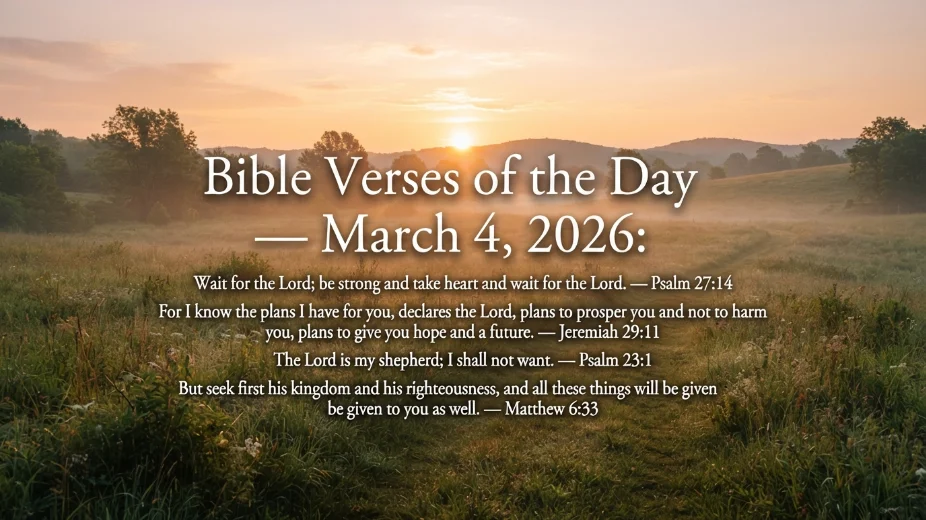
But here you are, on March 4, 2026 — alive, breathing, with a new 24 hours stretched out before you. And whether this day feels like a gift or a burden right now, God’s Word has something specific and powerful to say into it.
There is something deeply meaningful about seeking a Bible verse for today — not a general scripture, not a verse from last month’s devotional, but a word from God anchored to this exact moment in time. It’s the recognition that God is not distant or silent, that His truth is not locked in the ancient past, but that it speaks directly and personally into the living, breathing reality of March 4, 2026 — your struggles, your hopes, your ordinary Wednesday, and whatever extraordinary thing God is working beneath the surface of it.
The practice of daily Scripture reading is one of the oldest and most spiritually powerful habits in the Christian life. Jesus quoted Scripture when He was tempted. The psalmists meditated on God’s Word day and night. The early church devoted themselves to the apostles’ teaching as their daily bread. And for millions of believers around the world today, a daily Bible verse is the anchor that keeps the soul steady when everything else is shifting.
This article is your companion for today. We’ve gathered rich, carefully selected scriptures, organized them thematically, and unpacked each one with the depth, context, and practical application it deserves — so that God’s Word doesn’t just pass through your eyes today, but takes root in your heart and changes how you move through March 4, 2026.
Quick Answer: What Is the Bible Verse of the Day for March 4, 2026?
The Bible verse of the day for March 4, 2026 is drawn from one of the most beloved promises in the New Testament:
Philippians 4:6–7 (NIV): “Do not be anxious about anything, but in every situation, by prayer and petition, with thanksgiving, present your requests to God. And the peace of God, which transcends all understanding, will guard your hearts and your minds in Christ Jesus.”
This verse speaks directly to the anxiety, uncertainty, and mental burden that so many people carry into a new day. It is not just a command to stop worrying — it is an invitation into a specific spiritual practice (prayer with thanksgiving) that opens the door to supernatural peace. This is God’s word for your Wednesday. But read on — we’ve gathered an entire day’s worth of Scripture arranged by theme, each one equipped with practical application for where you are right now.
Why Daily Bible Verses Matter: The Spiritual Power of Today’s Scripture
Before we open each verse, it’s worth pausing to ask: why does seeking today’s Bible verse carry such significance for so many believers?
The answer is found in the nature of God’s Word itself. Hebrews 4:12 tells us that the Word of God is “alive and active” — not static, not archived, but dynamically living. It is not a historical document that was once powerful; it is a present-tense communication from a present-tense God who is actively involved in your March 4, 2026.
When you seek a Bible verse for today specifically, you are doing something spiritually deliberate: you are positioning yourself to receive fresh manna. In Exodus 16, God provided manna for the Israelites daily — they could not stockpile last week’s supply; they had to gather it new each morning. This is a picture of how God designed our spiritual nourishment to work. Yesterday’s devotional was good. But today requires today’s Word.
Jesus reinforced this when He taught us to pray “give us this day our daily bread” (Matthew 6:11). Spiritual bread — God’s Word, His presence, His guidance — is meant to be sought freshly, daily, consistently. A daily Bible verse practice is not a religious ritual; it is the spiritual equivalent of eating breakfast before a long day.
March 4, 2026 Bible Verses on Peace and Releasing Anxiety
Philippians 4:6–7 — The Peace That Stands Guard
“Do not be anxious about anything, but in every situation, by prayer and petition, with thanksgiving, present your requests to God. And the peace of God, which transcends all understanding, will guard your hearts and your minds in Christ Jesus.”
Context and Meaning: Paul wrote this letter from a Roman prison — not from a comfortable study or a place of ease, but from chains. That context transforms this verse from a pleasant platitude into a radical declaration. The man telling you not to be anxious could not control his own circumstances, his release date, or his physical safety. And yet he had discovered something that circumstances cannot give and cannot take away: a peace that transcends (surpasses, goes beyond) human understanding.
The word “guard” here is a Greek military term (phroureo) — the image is of God’s peace standing as a sentinel at the gate of your heart and mind, turning away the attacks of anxiety before they can take root. This peace is not passive; it is active, protective, and powerful.
Practical Application for March 4: Whatever is generating anxiety in your life today — write it down. Then, following Paul’s exact formula, bring each item to God in prayer with thanksgiving (thanking Him for His faithfulness before the answer arrives). This is not positive thinking; it is faith-activated prayer that opens the door to supernatural peace. Try it this morning before your day begins in earnest.
Why It Matters Today: We live in an age of unprecedented anxiety. Medical statistics consistently show anxiety as one of the most prevalent conditions of the modern era. God’s Word — written 2,000 years ago — offers not a coping mechanism but a genuine antidote. The peace that guarded Paul’s heart in prison can guard yours on March 4, 2026.
Isaiah 26:3 — The Kept Mind
“You will keep in perfect peace those whose minds are stayed on you, because they trust in you.”
Context and Meaning: The Hebrew phrase for “perfect peace” is shalom shalom — the word shalom doubled for emphasis, indicating completeness, wholeness, and utter wellbeing. It’s not just the absence of conflict; it’s the presence of everything that belongs to a flourishing life. And the condition for receiving it? A mind that is stayed (steadily fixed, anchored, leaning) on God.
Practical Application for March 4: Where is your mind fixed this morning? On the problem? On the news? On what might go wrong? This verse invites you to a practice of intentional mental redirection — not denial of your circumstances, but a deliberate choice to anchor your thoughts to God’s character and promises before you anchor them to your problems. What would it look like to make that shift for just the next hour?
March 4, 2026 Bible Verses on Strength and Courage
Joshua 1:9 — God’s Word for Your Wednesday
“Have I not commanded you? Be strong and courageous. Do not be afraid; do not be discouraged, for the Lord your God will be with you wherever you go.”
Context and Meaning: God spoke these words to Joshua as he prepared to lead Israel into Canaan — a task of terrifying proportions. Joshua had to follow in the footsteps of Moses (the greatest leader Israel had ever known) and lead millions of people into conflict with nations mightier than themselves. The challenge was not small. And God’s instruction was not “don’t worry, it’ll be easy.” It was: I will be with you. That is the source of courage — not confidence in your own strength, but confidence in the presence of an all-powerful God.
Practical Application for March 4: What is the intimidating thing you’re facing today? The hard conversation? The medical appointment? The job interview? The financial decision? Whatever your “Canaan” is this Wednesday, this verse is God’s direct word to you: be strong and courageous — not because you have it all figured out, but because He goes with you into every moment of this day.
Why It Matters Today: Discouragement is one of the most effective tools the enemy uses to neutralize believers. It doesn’t have to be dramatic — a slow leak of hope over days and weeks can flatten even the strongest faith. This verse is a refilling station. Read it aloud. Let it push back against the discouragement that may have crept in before this day even began.
Psalm 46:1–2 — When Today Feels Overwhelming
“God is our refuge and strength, an ever-present help in trouble. Therefore we will not fear, though the earth give way and the mountains fall into the heart of the sea.”
Context and Meaning: The psalmist is using hyperbole — “even if the most stable, immovable things in the world collapse” — to make a theological point: God’s stability transcends even the most catastrophic earthly instability. The phrase “ever-present help” in Hebrew is nimtsa meod — literally “found very much.” God is not a help you have to search for; He is immediately, abundantly available in trouble.
Practical Application for March 4: If March 4, 2026 has brought — or is bringing — something that feels like the ground giving way under your feet, this verse is your bedrock. You don’t have to have yourself together before you can access God’s strength. You just have to turn to it. He is already there, already present, already a refuge. You only need to run to what is already waiting.
March 4, 2026 Bible Verses on God’s Faithfulness and Promises
Lamentations 3:22–23 — New Mercies for a New Day
“Because of the Lord’s great love we are not consumed, for his compassions never fail. They are new every morning; great is your faithfulness.”
Context and Meaning: These are some of the most hope-generating words in all of Scripture — made more remarkable by their context. The prophet Jeremiah wrote these words in the immediate aftermath of Jerusalem’s destruction. He was surrounded by ash and grief. And from that wreckage, he articulated the most radical act of faith: God’s mercies are new every morning. Not recycled. Not leftover. Freshly generated by a God whose faithfulness never fluctuates.
Practical Application for March 4: This morning — March 4, 2026 — is a new morning. Whatever yesterday carried: the failure, the discouragement, the sin confessed or not yet confessed, the disappointment, the wound — God’s mercy is not yesterday’s mercy stretched thin. It is new. It is full. It is waiting for you to receive it right now. Begin this day by receiving what is being freely offered.
Why It Matters Today: We carry yesterday into today so naturally, so automatically, that we often don’t notice we’re doing it. This verse is a daily invitation to put down yesterday’s weight at the threshold of a new morning and walk into March 4 carrying only what belongs to today. His faithfulness is great — and it is yours, fresh, this morning.
Romans 8:28 — The Confidence That Holds Every Day Together
“And we know that in all things God works for the good of those who love him, who have been called according to his purpose.”
Context and Meaning: The word “know” here (oidamen in Greek) is a word of settled, certain knowledge — not hoping, not suspecting, but knowing. Paul is expressing a confidence rooted not in circumstances but in the character of God. “All things” does not mean all things are good — it means God works in all things, including the painful, confusing, and broken ones, to produce good for those who love Him. The good He is working toward is conformity to the image of Christ (Romans 8:29) — which is the deepest good a human being can experience.
Practical Application for March 4: That difficult situation you cannot make sense of right now — the one that doesn’t feel like it could possibly be working toward anything good — this verse does not require you to pretend it’s fine. It asks you to trust that a God who sees the whole tapestry is weaving even the dark threads into something beautiful. That is not naive; that is the most well-founded confidence in the universe.
Jeremiah 29:11 — God’s Plans Are Already Written
“‘For I know the plans I have for you,’ declares the Lord, ‘plans to prosper you and not to harm you, plans to give you hope and a future.'”
Context and Meaning: This verse is among the most frequently cited in Christian culture — and it’s important to understand its full context, which actually deepens rather than diminishes its power. God spoke these words to the Israelites during the Babylonian exile — a season of tremendous loss, displacement, and pain. He then told them it would last seventy years (Jeremiah 29:10). He wasn’t promising immediate rescue; He was promising ultimate purpose. Even in a seventy-year detour, His plans for a hope and a future remained intact.
Practical Application for March 4: If your life feels like an exile season right now — if you’re in the middle of something long and hard and unclear — this verse is for you in a deep way. The plans God has for your hope and future are not cancelled by your current circumstance. They are not derailed by the length of the wait. They were spoken over you before you were born, and they hold on March 4, 2026, regardless of where you are in the journey.
March 4, 2026 Bible Verses on Love, Grace, and Identity in Christ
Romans 8:38–39 — Nothing Can Separate You From This
“For I am convinced that neither death nor life, neither angels nor demons, neither the present nor the future, nor any powers, neither height nor depth, nor anything else in all creation, will be able to separate us from the love of God that is in Christ Jesus our Lord.”
Context and Meaning: Paul exhausts the vocabulary of opposition — death, life, angels, demons, present, future, cosmic powers, dimensions of space — and declares that not one of them, not all of them combined, can sever the believer from God’s love. The word “convinced” (pepeismai) is in the perfect tense, indicating a settled, completed certainty. This is not wishful thinking; it is Paul’s considered, Spirit-led declaration of an unbreakable bond.
Practical Application for March 4: On days when you feel far from God — when the spiritual fog is thick and prayer feels hollow — this verse stands as an objective, unchanging reality: you have not drifted beyond His love. You cannot. His love is not contingent on your feelings about it. It is a fact as settled as the laws of physics — and considerably more reliable.
Ephesians 2:10 — Who You Are on March 4, 2026
“For we are God’s handiwork, created in Christ Jesus to do good works, which God prepared in advance for us to do.”
Context and Meaning: The Greek word for “handiwork” is poiema — from which we derive the English word “poem.” You are God’s poem. His masterpiece. His creative work. Not a mistake, not an accident, not a rough draft. And the good works God prepared for you are not generic — they are specific, pre-arranged, custom-fitted to who you are and where you are. On March 4, 2026, there are things prepared for you to do that only you can do in exactly the way you will do them.
Practical Application for March 4: This verse reframes what it means to have an ordinary Wednesday. You are not just going through the motions today — you are walking into divinely prepared moments. The conversation you’ll have, the kindness you’ll show, the work you’ll do with integrity, the encouragement you’ll offer — these may be the very good works God had in mind for you on this specific day. Walk into March 4 with that awareness.
March 4, 2026 Bible Verses on Prayer, Trust, and Surrender
Proverbs 3:5–6 — The Verse That Redirects Everything
“Trust in the Lord with all your heart and lean not on your own understanding; in all your ways submit to him, and he will make your paths straight.”
Context and Meaning: Solomon wrote this as foundational wisdom for living well. The instruction has two parts: a positive command (trust with all your heart, submit in all your ways) and a negative command (don’t lean on your own understanding). The word “lean” here (sha’an) means to put your weight on something, to depend on it for support. The warning is against making your own limited understanding the primary load-bearing wall of your decisions.
Practical Application for March 4: What decision are you trying to figure out entirely on your own right now? What situation are you analyzing to the point of exhaustion because you can’t make sense of it? This verse invites you to loosen your grip on needing to understand before you trust. Submit the confusion itself to God — not just the decision, but the uncertainty around it. He will make your path straight, even when you can’t see the straightness yet.
Matthew 6:33 — The Priority That Reorders Everything Else
“But seek first his kingdom and his righteousness, and all these things will be given to you as well.”
Context and Meaning: Jesus spoke this in the Sermon on the Mount, in the context of a teaching on worry and provision. “All these things” refers to the practical necessities of life — food, clothing, shelter — that His listeners were anxious about. His solution was not a budget strategy or a productivity plan; it was a reordering of priorities. Seek God’s kingdom first — make that the primary pursuit — and the things you genuinely need will be provided.
Practical Application for March 4: Before you pursue what you want today, what are you doing to seek God’s kingdom? Even ten minutes in Scripture or prayer at the beginning of your day constitutes a meaningful act of seeking first. The promise attached to that seeking is among the most practical in the Bible: God takes care of the provision of those whose primary pursuit is His kingdom.
How to Use Today’s Bible Verses Throughout March 4, 2026
Reading powerful scriptures in the morning is a wonderful start — but the real transformation happens when God’s Word stays with you through the whole day. Here are practical ways to carry today’s verses into every hour of March 4:
Morning (6:00–9:00 AM) — Receive: Choose one verse from today’s selection and read it slowly, three times. Then sit quietly for two minutes. Don’t ask for anything. Just let the Word settle into your spirit like water into dry ground.
Mid-Morning (9:00–12:00 PM) — Anchor: When the day’s demands start pulling you in multiple directions, return to your chosen verse. Write it on a sticky note near your workspace. Set it as your phone lock screen. Let it be the anchor you return to when distraction or stress increases.
Afternoon (12:00–5:00 PM) — Apply: Ask yourself: “How does today’s verse apply to what I’m experiencing right now?” The meeting that frustrated you — can you see it through the lens of Romans 8:28? The anxious thought that won’t leave — can you bring it to God using Philippians 4:6–7? Scripture becomes transformative when it moves from information to application.
Evening (5:00 PM onward) — Reflect: Before you sleep, spend five minutes reviewing your day in light of this morning’s scriptures. Where did you experience God’s faithfulness? Where did you fall short of living out His Word? Bring both to Him honestly. Close with gratitude for the specific mercies of March 4, 2026. Tomorrow, His mercies will be new again.
A Prayer for March 4, 2026
Lord, thank You for this day — March 4, 2026. Thank You that it is not an accident, not a gap between more important days, but a day You have made with intention and filled with Your presence.
I bring to You everything that is generating anxiety in my heart this morning. I name it before You: [the worry, the fear, the uncertainty]. I choose, as Paul taught, to present it to You with thanksgiving — thanking You that You already know the outcome, that Your plans for me are good, and that Your peace is already available.
Guard my heart and mind today, Lord. Station Your peace at the gates of my thoughts. When fear tries to enter, let Your Word speak louder. When discouragement tries to settle, let the truth of Your faithfulness rise up.
Make me aware today of the good works You prepared for me before this day began. Let me not sleepwalk through March 4 — let me walk through it awake, present, and available to be used by You in the lives of the people I encounter.
Where I am confused, give me trust. Where I am afraid, give me courage rooted in Your presence. Where I am discouraged, remind me that You are working in all things — including the thing that makes no sense right now.
Let today be marked not just by what I accomplish, but by who I am choosing to be in You. I trust You with March 4, 2026. Every hour of it.
In Jesus’ name, Amen.
Frequently Asked Questions
1. What is a Bible verse of the day, and how should I use it?
A Bible verse of the day is a single scripture or small passage selected for daily meditation and spiritual focus. It serves as a spiritual anchor — a truth to carry through the day, return to when stressed, and reflect on at night. The most effective way to use it is not just to read it once, but to read it slowly multiple times in the morning, write it somewhere visible, apply it to specific situations throughout the day, and close the evening by reflecting on how it showed up in your experience.
2. Why do Christians seek a specific Bible verse for today’s date?
Seeking a scripture for a specific date reflects the biblical practice of seeking God’s fresh word each day — much like the Israelites gathered manna daily in the wilderness (Exodus 16). It also reflects an understanding of God as actively present in real time: not a distant deity who spoke only in antiquity, but a living God whose Word continues to speak into specific moments, specific dates, and specific lives. A date-specific devotional habit keeps faith personal, present, and grounded in daily reality rather than abstract theology.
3. Is March significant in Scripture or in the Christian calendar?
March, as a calendar month, does not appear in Scripture, which uses a lunar calendar with different month names. However, March in the Christian liturgical tradition often falls within the season of Lent — the 40-day period of reflection, repentance, and preparation leading up to Easter. March 4 in 2026 falls within the Lenten season, making it a particularly fitting time for scriptures on renewal, seeking God, releasing anxiety, and trusting His purposes. The themes of preparation, waiting, and trust are deeply Lenten themes with rich scriptural support.
4. What is the most encouraging Bible verse for difficult days?
Several scriptures consistently rank among the most encouraging for hard days: Romans 8:28 (God works all things for good), Isaiah 41:10 (do not fear, God is with you), Lamentations 3:22–23 (new mercies every morning), Psalm 34:18 (God is close to the brokenhearted), and Jeremiah 29:11 (plans for hope and a future). The “best” verse is always the one that speaks most directly to your specific situation. On difficult days, it often helps to read a full Psalm (like Psalm 23, 34, or 46) rather than a single verse, as the extended narrative of trust and praise can carry you further.
5. How do I make daily Bible reading a consistent habit?
Consistency in daily Bible reading is built through three things: a set time, a set place, and a simple plan. Choose a time that already has a hook (with your morning coffee, immediately after waking, before lunch), a place that’s comfortable and relatively distraction-free, and a plan simple enough to actually follow — one verse, one Psalm, or one chapter. The goal is not volume; it is consistency. Five minutes of daily Scripture reading, maintained for a year, will transform your faith more than an occasional two-hour reading marathon. Start small, stay faithful, and let the habit deepen naturally.
6. What does “Bible verse of the day” mean on apps and websites?
Daily Bible verse features on apps and websites (YouVersion Bible App, Bible Gateway, Faithlife, and others) provide a curated scripture each day, often with a brief devotional thought. These are excellent tools for beginning a daily Scripture habit. Many also provide reading plans, verse sharing features, and community elements that can deepen engagement. The verse of the day is typically selected by editorial teams or through systematic Bible reading plans rather than algorithmically, though curation methods vary by platform.
7. How do I choose which Bible translation to read my daily verse in?
The best translation is the one you’ll actually read and understand. The NIV (New International Version) is widely considered the best balance of accuracy and readability for modern English speakers. The ESV (English Standard Version) offers slightly more literal translation while remaining readable. The NLT (New Living Translation) is excellent for those who find traditional Bible language difficult to understand. The NKJV and KJV offer beautiful, traditional language for those who prefer it. For deep study, comparing two or three translations of the same verse can significantly enrich understanding.
8. Can reading a daily Bible verse really change my life?
Yes — with one important qualifier. Reading a verse is the beginning, not the end. James 1:22 warns against being “hearers only” who deceive themselves. The transformative power of Scripture is activated through meditation (dwelling on it), application (living it out), and prayer (responding to God about it). Psalm 1:2–3 describes the person who meditates on God’s law day and night as being “like a tree planted by streams of water, which yields its fruit in season and whose leaf does not wither.” Daily Scripture is not magic; it is nourishment. And consistent nourishment, over time, produces unmistakable growth.
9. What if I don’t feel anything when I read today’s Bible verse?
This is one of the most common and honest questions in the Christian life, and the answer is important: spiritual feelings are not the measure of spiritual reality. You can read God’s Word on a day when it seems flat, when no emotion stirs, when the words feel distant — and that Word is still doing its work in you. Hebrews 4:12 says it is “alive and active,” not “alive and active when you feel it.” Many of the deepest scriptural formations happen in seasons of apparent dryness, when the Word is being laid down in the spirit like unseen roots before any visible growth. Keep reading. Keep showing up. The fruit comes.
10. How is seeking a daily Bible verse different from superstition or “Bible roulette”?
Seeking a daily Bible verse becomes superstition when it’s used as a fortune-telling device — randomly opening the Bible hoping for a specific answer to a specific question, or treating a single verse as a guaranteed prediction of the day’s events. Biblical daily devotion is different: it is the deliberate, prayerful, consistent practice of placing yourself before God’s Word to be shaped by His truth, to be reminded of His character, and to be nourished spiritually. It is relationship with the Author, not consultation of an oracle. The difference lies in the posture: are you seeking God through His Word, or seeking information from a text? The former transforms you; the latter can mislead you.
Closing Encouragement:
You opened this article looking for a word from God for today. And here is the deepest truth we can offer you as you close it and walk back into your Wednesday:
God knew March 4, 2026 was coming before you were born. He knew you would be alive on this day. He knew what this morning would hold for you, what the afternoon would bring, what the evening would carry. And He has not left you resourceless for any of it.
The scriptures you read today are not historical artifacts — they are living letters written by a God who loves you with a love that death itself could not interrupt. The peace of Philippians 4, the faithfulness of Lamentations 3, the presence of Joshua 1, the love of Romans 8 — these are not ancient promises that have expired. They are yours. Today. On March 4, 2026. In your specific situation, with your specific name, in the specific mercy that was generated fresh for you this morning.
Don’t let the day swallow you whole. Take today’s Word with you into every room you enter, every conversation you have, every decision you face. Let it be the undercurrent of a Wednesday that might look ordinary on the outside but is, in the hands of a faithful God, anything but ordinary.
He is with you today. He is working today. And His mercies for tomorrow are already being prepared.
“The Lord your God is with you, the Mighty Warrior who saves. He will take great delight in you; in his love he will no longer rebuke you, but will rejoice over you with singing.” — Zephaniah 3:17
Go into your March 4, 2026 knowing that the God of the universe is singing over you.
That is more than enough for today.
Key scriptures referenced in this article: Philippians 4:6–7 | Isaiah 26:3 | Joshua 1:9 | Psalm 46:1–2 | Lamentations 3:22–23 | Romans 8:28 | Jeremiah 29:11 | Romans 8:38–39 | Ephesians 2:10 | Proverbs 3:5–6 | Matthew 6:33 | Hebrews 4:12 | Psalm 1:2–3 | James 1:22 | Zephaniah 3:17 | Matthew 6:11 | Exodus 16
