
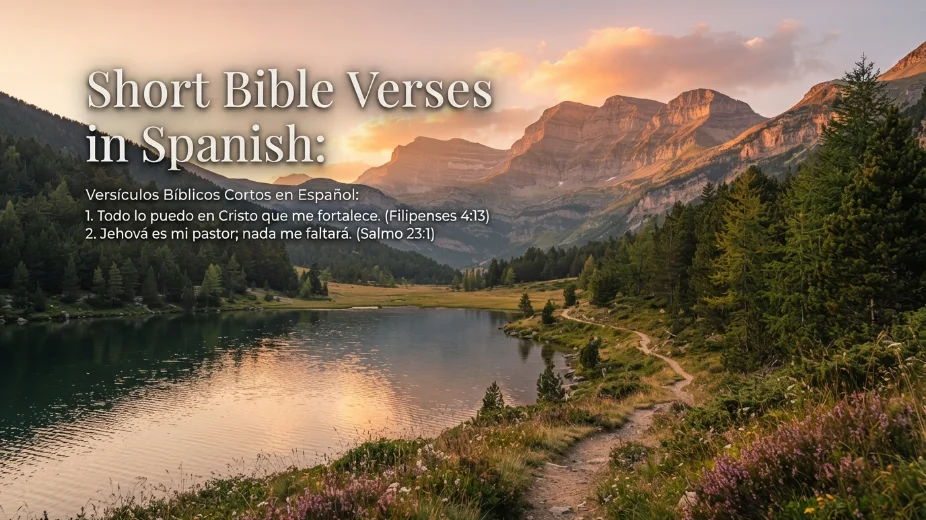
There are moments in life when words fail us entirely.
Maybe you’re sitting with a friend who just received a devastating diagnosis and you don’t know what to say. Maybe you’re a first-generation immigrant trying to hold your faith together in a new country where everything feels unfamiliar — including the language of the church you grew up in. Maybe you’re a parent raising bilingual children and you want Scripture to take root in both languages of their hearts. Or maybe you simply need one short, powerful line from God’s Word to get you through a Tuesday afternoon that feels heavier than it should.
Short Bible verses in Spanish carry a particular kind of power. The Spanish language has a warmth and expressiveness that gives Scripture an almost musical quality — “Dios es amor” (God is love) lands in the soul differently than it does in any other tongue. For over 500 million Spanish speakers around the world, the Bible in Spanish is not a translation — it is home. It is the language of their mothers’ prayers, their grandmothers’ whispered blessings, their first encounters with the living God.
But even for those learning Spanish, sharing Spanish Bible verses is an act of love and cultural bridge-building. It says: your language matters to God. Your culture matters to God. He speaks your language.
This article is a comprehensive, carefully researched guide to the most powerful, most memorized, and most beloved short Bible verses in Spanish — organized by theme, explained with biblical depth, and offered as practical tools for daily faith, sharing, encouragement, and spiritual growth.
Whether you are a Spanish-speaking believer, a bilingual Christian, a pastor, a missionary, a parent, or simply someone who wants to carry God’s Word in more than one language — this resource is for you.
Quick Answer: What Are the Most Popular Short Bible Verses in Spanish?
Short Bible verses in Spanish are concise scriptures — typically one to two sentences — from the Reina-Valera (RVR) or Nueva Versión Internacional (NVI) translations that capture a complete biblical truth in memorable, shareable form. They are widely used for:
- Daily devotionals and morning/evening prayers
- Social media posts and WhatsApp messages
- Memory verse programs for children and adults
- Encouragement cards, gifts, and wall art
- Evangelism and outreach in Spanish-speaking communities
- Tattoos, jewelry, and meaningful keepsakes
The most searched and widely shared short Spanish Bible verses include:
- “Todo lo puedo en Cristo que me fortalece.” — Filipenses 4:13
- “Dios es amor.” — 1 Juan 4:8
- “El Señor es mi pastor.” — Salmos 23:1
- “Porque de tal manera amó Dios al mundo…” — Juan 3:16
- “Confía en el Señor con todo tu corazón.” — Proverbios 3:5
Why the Spanish Bible Translation Matters: A Brief Background
Before diving into the verses themselves, it helps to understand the translations most Spanish-speaking Christians use — because the choice of translation affects the exact wording of the verses you’ll find shared online and in churches.
Reina-Valera 1960 (RVR1960): The most widely used Spanish Bible in Latin American and Hispanic Protestant communities. It has the same weight and reverence in the Spanish-speaking world that the King James Version holds in English — beloved for its poetic, elevated language and centuries of tradition.
Nueva Versión Internacional (NVI): The Spanish equivalent of the New International Version, this translation prioritizes clarity and modern readability. It’s widely used in contemporary worship, youth ministry, and new believer contexts.
Dios Habla Hoy (DHH): A conversational, easy-to-understand translation used often in children’s ministry and with new believers.
Throughout this article, verses will primarily appear in the RVR1960 — the most recognized and memorized version — with NVI noted where the phrasing is significantly different or especially powerful.
Short Bible Verses in Spanish Organized by Theme
Theme 1: Versículos Sobre el Amor de Dios — Verses About God’s Love
God’s love is the foundation of the entire Christian faith, and no theme appears more frequently in both testaments. These short verses on God’s love are among the most memorized and shared across all Spanish-speaking communities.
Juan 3:16 (RVR1960) “Porque de tal manera amó Dios al mundo, que ha dado a su Hijo unigénito, para que todo aquel que en él cree, no se pierda, mas tenga vida eterna.”
Meaning and Context: This is perhaps the single most recognized verse in all of Christendom. Jesus spoke it to Nicodemus, a Pharisee who came seeking truth at night. The phrase “de tal manera” (in such a way, so much) carries the weight of God’s incomprehensible love — not merely its existence, but its extravagance. God didn’t love quietly or cautiously; He loved at maximum cost.
Practical Application: When you question whether God truly loves you — not in general, but you specifically — return to this verse. The word “todo aquel” (whoever, everyone) leaves no one outside its reach.
Relevance Today: In a world where love is often conditional and performance-based, this verse announces a love measured by sacrifice, not sentiment.
1 Juan 4:8 (RVR1960) “El que no ama, no ha conocido a Dios; porque Dios es amor.”
Meaning and Context: John’s declaration that “God is love” (Dios es amor) is perhaps the shortest and most theologically dense statement in all of Scripture. It does not merely say God has love or shows love — it says love is part of His essential nature. To truly know God is to be transformed by love.
Practical Application: This verse is a spiritual diagnostic. If you find it increasingly easy to love others — patiently, generously, without keeping score — you are growing closer to the nature of God.
Relevance Today: Three words. Dios es amor. Tattoos, murals, text messages, hospital room walls — this verse travels everywhere because it carries infinite weight in minimal space.
Romanos 8:38–39 (RVR1960) “Por lo cual estoy seguro de que ni la muerte, ni la vida… ni ninguna otra cosa creada nos podrá separar del amor de Dios.”
Meaning and Context: Paul writes from a place of hard-won certainty. He lists the most terrifying forces in human experience — death, life, angels, demons, present circumstances, future unknowns — and declares that not one of them has the power to cut you off from God’s love. Nada — nothing.
Practical Application: Share this verse with someone who feels abandoned by God in their suffering. It is the biblical answer to the feeling that God has turned away.
Theme 2: Versículos Sobre la Fe y la Confianza — Verses About Faith and Trust
Proverbios 3:5–6 (RVR1960) “Fíate de Jehová de todo tu corazón, y no te apoyes en tu propia prudencia. Reconócele en todos tus caminos, y él enderezará tus veredas.”
Meaning and Context: The Hebrew word behind “fíate” is batach — it means to lean your full weight on something, like a person leaning against a solid wall. God is not asking for partial trust. He’s asking you to lean your entire weight against Him. The instruction to “not lean on your own understanding” isn’t a dismissal of intelligence — it’s a recognition that human wisdom, even at its best, is limited.
Practical Application: Facing a major decision? Battling confusion about your direction? This verse is not vague spiritual advice — it’s a navigational system. Acknowledge God in the specific path (your career, your relationship, your health decision) and He will direct your steps.
Relevance Today: In an age of self-optimization culture where we’re told to trust our gut, lean into our truth, and follow our instincts, this verse offers a counter-cultural anchor: trust God more than yourself.
Filipenses 4:13 (RVR1960) “Todo lo puedo en Cristo que me fortalece.”
Meaning and Context: This is one of the most memorized short Bible verses in Spanish and in any language. Paul wrote it from prison — not from a podium of success. The word “fortalece” (strengthens) is present tense and ongoing. Christ is not a one-time power source; He is a continuous strengthening.
Important Context Note: This verse is often misapplied as a promise of unlimited success or achievement. Paul’s context was learning contentment in both abundance and need (v.11–12). The “all things” refers to navigating all circumstances — not guaranteeing all outcomes.
Practical Application: When the task feels impossible, when you’re depleted and the week is only half over, this verse doesn’t promise that everything will work out perfectly — it promises that you will not face it alone, and that Christ’s strength supplements your weakness.
Isaías 41:10 (RVR1960) “No temas, porque yo estoy contigo; no desmayes, porque yo soy tu Dios que te esfuerzo.”
Meaning and Context: God spoke these words to Israel during a season of deep national anxiety. The command “no temas” (do not fear) appears over 365 times across Scripture — one for every day of the year, as many have noted. But the command is always paired with a reason: “porque yo estoy contigo” — because I am with you. The antidote to fear is presence, and God offers His.
Practical Application: Write this verse on a card and keep it where you encounter your most frequent anxiety — your car dashboard, your desk, your bathroom mirror. Read it aloud. The spoken word of God carries a specific power that silent reading does not.
Theme 3: Versículos Sobre la Paz — Verses About Peace
Filipenses 4:7 (RVR1960) “Y la paz de Dios, que sobrepasa todo entendimiento, guardará vuestros corazones y vuestros pensamientos en Cristo Jesús.”
Meaning and Context: The word “guard” (guardará) is a military term — it pictures a sentinel standing watch at the gate of a city. God’s peace is not passive; it actively stands guard over your heart and mind. And crucially, it surpasses understanding — which means you don’t have to fully understand your situation for this peace to be available to you.
Practical Application: This peace is accessed through prayer and gratitude (see the verses immediately before it, v.6). It’s not automatic — it’s the fruit of turning your anxiety into prayer.
Juan 14:27 (RVR1960) “La paz os dejo, mi paz os doy; yo no os la doy como el mundo la da.”
Meaning and Context: Jesus spoke these words in His farewell discourse — the night before His crucifixion. The peace He offers is fundamentally different from the world’s peace, which depends on favorable circumstances. His peace exists independently of circumstances because it is rooted in His presence and His sovereignty.
Practical Application: When circumstances are turbulent and peace seems irrational, this verse is the reminder that you’re not accessing the world’s peace — you’re accessing a different kind entirely. It is given (os doy) — received, not achieved.
Theme 4: Versículos Sobre la Fortaleza y la Esperanza — Verses About Strength and Hope
Isaías 40:31 (RVR1960) “Pero los que esperan a Jehová tendrán nuevas fuerzas; levantarán alas como las águilas.”
Meaning and Context: The verb “esperan” (wait, hope) is the Hebrew qavah — to be twisted together like cords in a rope. Waiting on God is not passive resignation; it’s active, faith-filled entwinement with Him. The eagle imagery speaks to something that defies human strength: soaring on thermal currents, not by frantic effort, but by resting in what rises beneath them.
Practical Application: When you are exhausted from striving, this verse invites a different posture. Stop flapping. Spread your wings. Let God’s strength carry what your effort cannot.
Jeremías 29:11 (RVR1960) “Porque yo sé los pensamientos que tengo acerca de vosotros, dice Jehová, pensamientos de paz, y no de mal, para daros el fin que esperáis.”
Meaning and Context: God spoke this to the Israelites in Babylonian exile — people who had lost everything familiar and were far from home. This was not a promise of immediate rescue. It was a promise of intentionality: I know what I am doing with you. The plans are purposeful, peaceful, and forward-looking.
Practical Application: For anyone who feels like their life is in pieces — career disrupted, relationship broken, health failing — this verse is not a guarantee that everything will snap back quickly. It’s deeper than that: it’s the assurance that God is thinking about you with intention and care, even now.
Salmos 46:1 (RVR1960) “Dios es nuestro amparo y fortaleza, nuestro pronto auxilio en las tribulaciones.”
Meaning and Context: The word “amparo” (refuge, shelter) paints God as a safe place to run to — not a distant deity who observes from afar, but a present stronghold. “Pronto auxilio” means readily available help — not help that will eventually come, but help that is already near.
Practical Application: Post this verse somewhere visible during a season of difficulty. Read it as a declaration, not just a wish. You are not alone in your tribulation. God is your first resort, not your last.
Theme 5: Versículos Para Compartir — Verses for Sharing and Encouragement
These short Spanish Bible verses are especially suitable for texting, social media captions, greeting cards, and encouraging others:
Salmos 118:24 (RVR1960) “Este es el día que hizo Jehová; nos gozaremos y alegraremos en él.” (This is the day the Lord has made; we will rejoice and be glad in it.)
Mateo 5:16 (RVR1960) “Así alumbre vuestra luz delante de los hombres.” (Let your light shine before others.)
1 Tesalonicenses 5:16–18 (RVR1960) “Estad siempre gozosos. Orad sin cesar. Dad gracias en todo.” (Rejoice always. Pray continually. Give thanks in all circumstances.)
Salmos 23:1 (RVR1960) “Jehová es mi pastor; nada me faltará.” (The Lord is my shepherd; I shall not want.)
Mateo 11:28 (RVR1960) “Venid a mí todos los que estáis trabajados y cargados, y yo os haré descansar.” (Come to me, all who are weary and burdened, and I will give you rest.)
How to Use Short Spanish Bible Verses in Daily Life
The most transformative relationship with Scripture happens not in occasional reading but in daily integration. Here are practical, concrete ways to carry short Bible verses in Spanish with you through every day:
1. The Morning Declaration Choose one verse from this list each week. Speak it aloud in Spanish every morning before you check your phone. The spoken Word, especially in a language close to your heart, has a way of settling deeply into the spirit.
2. WhatsApp and Text Blessings Spanish-speaking communities have a beautiful culture of sharing morning and evening blessings. Use short Bible verses as the anchor of these messages rather than generic motivational quotes. “Que tengas un día bendecido — ‘El Señor es mi pastor; nada me faltará.’ Salmos 23:1” is a gift of eternal weight.
3. Children’s Memory Verse Programs Short verses are ideal for memorization with children. Start with “Dios es amor” (1 Juan 4:8) for very young children, then progress to “Todo lo puedo en Cristo que me fortalece” (Filipenses 4:13) and “Confía en el Señor” (Proverbios 3:5). Set them to simple melodies — the Spanish language is naturally musical and children retain sung verses far longer.
4. Journaling in Both Languages If you journal, write the Spanish verse at the top of each entry alongside the English. Reflect on whether the verse feels different in each language, and what the Spanish phrasing reveals to you about the original meaning.
5. Home and Workspace Display Frame a short Spanish Bible verse for your kitchen, your office, your child’s bedroom. “Nada me faltará” above a kitchen table where food is shared carries a meaning that speaks daily without needing to be reread consciously.
6. Evangelism and Outreach For those doing ministry in Spanish-speaking communities, knowing these verses by heart — in Spanish — signals respect, love, and genuine engagement. It opens doors that tracts and programs cannot.
A Heartfelt Prayer in Spanish and English
Señor y Dios nuestro,
Te damos gracias por tu Palabra — que trasciende idiomas, culturas, y fronteras, y llega directamente al corazón humano. Gracias porque Tu verdad no necesita traducción para tocarnos profundamente.
Que cada versículo que leemos hoy no se quede solo en nuestra mente, sino que penetre hasta lo más profundo de nuestro ser. Que “Todo lo puedo en Cristo” no sea un dicho, sino una convicción que nos sostenga en los momentos difíciles. Que “Dios es amor” no sea solo teología, sino la realidad que transforma cómo amamos a los demás.
Para cada persona que busca Tu Palabra hoy en español — ya sea porque es su lengua materna o porque quieren honrar a alguien que habla español — bendícela con una comprensión más profunda de Tu amor. Que Tu Palabra sea lámpara a sus pies y lumbrera a su camino.
En el nombre de Jesús, Amén.
(Lord our God, we thank You for Your Word — which transcends languages, cultures, and borders, and reaches directly into the human heart. Thank You that Your truth needs no translation to touch us deeply. May every verse we read today not remain only in our minds, but penetrate to the very depth of our being. In Jesus’ name, Amen.)
10 Frequently Asked Questions
Q1: What is the most popular Bible verse in Spanish?
The single most widely recognized and shared Bible verse in Spanish is Juan 3:16: “Porque de tal manera amó Dios al mundo, que ha dado a su Hijo unigénito…” It is followed closely by Filipenses 4:13 (“Todo lo puedo en Cristo que me fortalece”), Salmos 23:1, and Jeremías 29:11. These four verses appear on more Spanish-language merchandise, social media posts, church murals, and tattoos than any others.
Q2: What is the best Spanish Bible translation for reading short verses?
For memorization and sharing, the Reina-Valera 1960 (RVR1960) is the gold standard among Spanish-speaking evangelical and Protestant communities. Its elevated, poetic language makes it ideal for memorization. For clarity and modern accessibility, the Nueva Versión Internacional (NVI) is excellent. Children and new believers often benefit from Dios Habla Hoy (DHH), which uses conversational, everyday language.
Q3: How do you say “God bless you” in Spanish using Scripture?
The most biblical way is to use the Aaronic Blessing from Números 6:24–26: “Jehová te bendiga y te guarde; Jehová haga resplandecer su rostro sobre ti… y te dé paz.” A shorter, commonly used blessing is simply “Que Dios te bendiga” (May God bless you), often accompanied by a verse like Salmos 121:8: “Jehová guardará tu salida y tu entrada desde ahora y para siempre.”
Q4: What is a short Bible verse in Spanish for strength?
The most popular short verse for strength in Spanish is Filipenses 4:13: “Todo lo puedo en Cristo que me fortalece.” Other powerful strength verses include Isaías 41:10 (“No temas, porque yo estoy contigo”) and Salmos 46:1 (“Dios es nuestro amparo y fortaleza”).
Q5: What are some short Spanish Bible verses for tattoos?
The most common short Bible verses chosen for tattoos in Spanish include: “Dios es amor” (1 Juan 4:8), “Todo lo puedo” (Filipenses 4:13 abbreviated), “Fe” with a reference, “Nada me faltará” (Salmos 23:1b), “No temas” (Isaías 41:10 abbreviated), and “Confía en Él”. These are chosen for their brevity, their beauty in the Spanish script, and their deeply personal meaning.
Q6: How can I teach short Bible verses in Spanish to children?
The most effective methods combine repetition, music, and visual association. Start with the shortest and most concrete verses: “Dios es amor”, “Jehová es mi pastor”, and “Estad siempre gozosos.” Set them to simple melodies. Use illustrated flashcards with the Spanish verse on one side and a drawing representing it on the other. Create a weekly memory verse chart with stickers as rewards. Repetition in context — praying the verse, applying it to daily situations, hearing parents use it naturally — is what makes it stick for life.
Q7: What are short Bible verses in Spanish for WhatsApp messages?
The most used short Bible verses for WhatsApp blessing messages in Spanish include: “El Señor te bendiga hoy y siempre — Números 6:24”, “Este es el día que hizo Jehová — Salmos 118:24”, “Nada podrá separarnos del amor de Dios — Romanos 8:39”, and “La paz de Dios guardará tu corazón — Filipenses 4:7.” These pair beautifully with sunrise images or floral graphics.
Q8: Are there short Spanish Bible verses specifically for hard times?
Yes. For seasons of difficulty, the most comforting short Spanish verses are: Salmos 34:18 (“Cercano está Jehová a los quebrantados de corazón” — The Lord is close to the brokenhearted), Mateo 11:28 (“Venid a mí… y yo os haré descansar”), Isaías 40:31, and Romanos 8:28 (“A los que aman a Dios, todas las cosas les ayudan a bien”). These speak directly to pain without minimizing it.
Q9: What is the difference between RVR1960 and NVI for short verses?
The difference is primarily stylistic and tonal. RVR1960 uses “vosotros” (plural you) and “Jehová” for God’s name, giving it a majestic, traditional sound. NVI uses “ustedes” and “el Señor,” making it feel more conversational and contemporary. For example, Proverbios 3:5 in RVR reads “Fíate de Jehová” while NVI reads “Confía en el Señor” — both powerful, but with distinct emotional registers. Many Spanish-speaking believers know certain verses exclusively in one translation, so it’s worth being aware of both.
Q10: Can learning Bible verses in Spanish strengthen my Spanish language skills?
Absolutely — and this is one of the most underrated benefits of memorizing Scripture in a second language. Short Bible verses provide high-frequency vocabulary, natural sentence structure, and emotionally resonant content that aids retention. They also open meaningful conversations. Memorizing even five to ten Spanish Bible verses gives a language learner both spiritual depth and practical cultural access in Spanish-speaking communities. Many missionaries and cross-cultural workers report that knowing Bible verses in the local language — spoken naturally — is one of the most powerful relationship-building tools available.
A Final Word:
There is something sacred about hearing — or reading — the Word of God in a language that goes all the way down to the roots of who you are.
For millions of Spanish speakers around the world, the Bible in Spanish isn’t simply a religious text. It’s the voice of God in their mother tongue. It’s their abuela’s whispered prayers. It’s the verse their father quoted when the rent was late and the pantry was thin. It’s the line they clung to when they crossed borders, survived loss, or knelt in a hospital waiting room.
And for those who are learning Spanish — or who love someone for whom Spanish is home — these verses are a bridge. They say: your language is not a barrier to God’s Word. It is a doorway into it.
Whether you carry “Dios es amor” on your skin, whisper “No temas, porque yo estoy contigo” before you walk into a difficult room, or text “Nada me faltará” to a friend who is scared — you are participating in a tradition thousands of years old. You are speaking the Word of God. And that Word, Scripture promises, does not return void.
“Así será mi palabra que sale de mi boca: no volverá a mí vacía.” — Isaías 55:11
Go with that Word in your heart. In whatever language it lives deepest in you — take it with you. And let it do what it has always done: illuminate, heal, strengthen, and bring you home to the God who spoke all languages into existence and calls every one of them beautiful.
“Tu palabra es una lámpara a mis pies, y una lumbrera a mi camino.” (Your word is a lamp to my feet and a light to my path.) — Salmos 119:105
Related Articles You May Enjoy:
- Short Bible Verses in English for Daily Encouragement
- Good Morning Bible Verses in Spanish
- Bible Verses About God’s Love in Spanish and English
- How to Start a Daily Bible Reading Habit in Spanish
- Spanish Prayers for Healing, Peace, and Strength
