
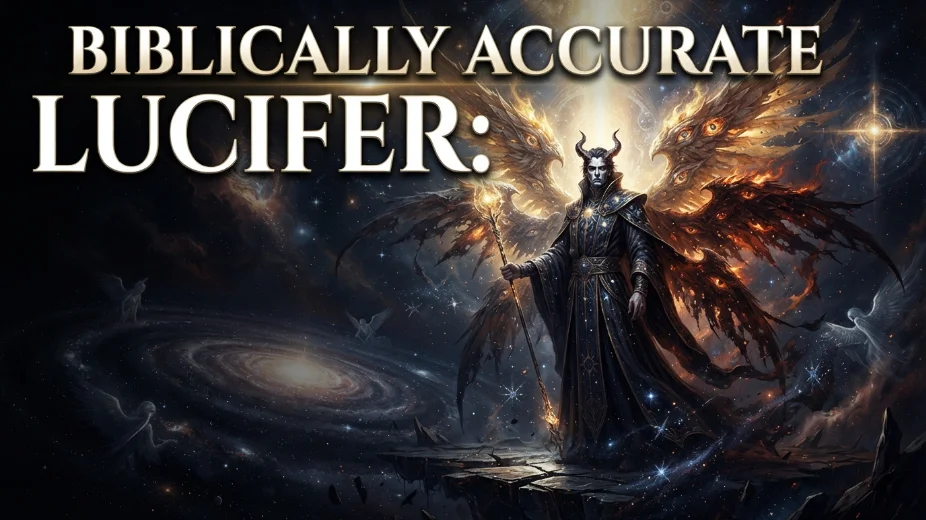
Have you ever sat in a church pew — or maybe scrolled through your phone late at night — wondering about the dark side of the spiritual world? Maybe a horror movie unsettled you, a friend asked a question you couldn’t answer, or your own doubts whispered, “What is the enemy actually capable of? Who is he, really?”
You are not alone. Millions of Christians carry quiet confusion about Lucifer — his true nature, where he came from, and what his existence means for their daily lives. Hollywood has given us a smooth-talking, red-skinned figure with horns and a pitchfork. Popular culture has turned the devil into both a comic villain and a dark anti-hero. Neither picture comes from the Bible.
The truth is both more sobering and more comforting than any fictional portrayal. When we understand who Lucifer actually is — according to Scripture — we gain something precious: clarity that dismantles fear, wisdom that strengthens faith, and the assurance that God has always been, and will always be, completely sovereign.
This article walks through everything the Bible genuinely teaches about Lucifer — his created glory, his catastrophic fall, his current activity, and his certain defeat. Whether you are a new believer looking for solid answers or a seasoned Christian wanting to confirm what Scripture actually says, this is written for you.
Quick Answer: What Does the Bible Say About Lucifer?
The name “Lucifer” appears once in most traditional Bible translations — in Isaiah 14:12 (KJV) — where it is a Latin rendering of the Hebrew helel ben shachar, meaning “shining one” or “son of the dawn.” Scripture teaches that Lucifer was an extraordinarily beautiful, high-ranking angelic being created by God who, because of pride and a desire to exalt himself above God, rebelled and was cast from heaven. He is identified across Scripture as Satan (“the adversary”), the devil (“the accuser”), a murderer, a liar, and the deceiver of nations. He is a created being — not equal to God, not omniscient, not omnipresent — who operates under God’s sovereign permission and whose ultimate defeat is already sealed in the finished work of Jesus Christ.
The Name “Lucifer”: What It Really Means in Scripture
Isaiah 14:12 — The Only Verse That Uses the Name
“How you have fallen from heaven, O morning star, son of the dawn! You have been cast down to the earth, you who once laid low the nations!” — Isaiah 14:12 (NIV)
In the King James Version, this verse reads: “How art thou fallen from heaven, O Lucifer, son of the morning!” The word “Lucifer” comes from the Latin Vulgate translation, where Jerome used lucifer (light-bearer) to render the Hebrew helel. In modern translations, it is rendered “morning star,” “shining one,” or “star of the dawn.”
Context matters enormously here. Isaiah 14 is primarily a taunt against the King of Babylon — a historical human ruler notorious for his arrogance and cruelty. However, the language rapidly transcends the earthly king and addresses a spiritual reality behind him. This is a common prophetic pattern in Scripture, where an earthly figure becomes a window into a corresponding spiritual power (see also Ezekiel 28 regarding the King of Tyre).
Practical application: When we see arrogance and self-exaltation in the world — in governments, institutions, or our own hearts — Isaiah 14 reminds us that the spirit behind pride has an ancient history. God brought the original prideful rebel low, and He will do so again.
What “Morning Star” Communicates
The imagery of a “morning star” or “shining one” tells us something important: Lucifer was not created evil. He was created glorious — radiant, brilliant, and exalted among God’s heavenly beings. His original name reflects original beauty. This matters because it answers the age-old question, “Did God create evil?” No. God created a magnificent being who chose, through pride, to corrupt himself.
The Most Detailed Portrait: Ezekiel 28 and the King of Tyre
A Passage That Goes Beyond Human History
“You were the seal of perfection, full of wisdom and perfect in beauty. You were in Eden, the garden of God; every precious stone adorned you… You were anointed as a guardian cherub, for so I ordained you. You were on the holy mountain of God; you walked among the fiery stones.” — Ezekiel 28:12–14
The prophet Ezekiel directs a lament against the King of Tyre — but by verse 12, the description has moved beyond any human ruler. No earthly king was “in Eden,” no human was ordained as a “guardian cherub,” and no mortal walked “among the fiery stones” of God’s holy mountain.
What Ezekiel Reveals About Lucifer’s Original State
Three defining characteristics emerge from this passage:
1. Created Perfection The text says he was “the seal of perfection” — a figure so flawless in wisdom and beauty that he stood as the pinnacle of angelic creation. This was not boasting. It was simply his God-given reality.
2. Exalted Position He is called a “guardian cherub” — one of the highest angelic ranks, associated with the very presence of God (see Genesis 3:24 and Exodus 25:22 where cherubim guard sacred space). He did not serve from a distance. He dwelt in the very atmosphere of God’s glory.
3. Adorned Glory The precious stones listed — sardius, topaz, diamond, beryl, onyx, jasper, sapphire, turquoise, and emerald — mirror the breastplate of Israel’s High Priest (Exodus 28:17–20). This language communicates priestly, representative dignity. He was not just powerful; he was beautifully made.
Why this matters for believers today: Understanding Lucifer’s original glory helps us understand the nature of our enemy’s deception. He doesn’t always appear dark and frightening. Paul warns in 2 Corinthians 11:14, “Satan himself masquerades as an angel of light.” A being that was once genuinely radiant still knows how to imitate light.
The Catastrophic Fall: Why Lucifer Became Satan
Pride — The Root Sin
“Your heart became proud on account of your beauty, and you corrupted your wisdom because of your splendor. So I threw you to the earth.” — Ezekiel 28:17
“You said in your heart, ‘I will ascend to the heavens; I will raise my throne above the stars of God… I will make myself like the Most High.'” — Isaiah 14:13–14
The fall of Lucifer was not caused by ignorance, weakness, or external temptation. It was caused by pride — the decision to look inward at his own glory and choose himself over God. Five times in Isaiah 14:13–14, he says “I will” — a stunning declaration of self-will against divine will.
The progression of Lucifer’s pride:
- He noticed his own beauty (which was given, not earned)
- He valued it more than his relationship with God
- He acted on that valuation by seeking to elevate himself
- He fell as a direct consequence
This is the anatomy of sin — not just for angels, but for human beings. James 1:14–15 traces the same pattern: desire → conception → sin → death.
Jesus Himself Confirmed the Fall
“I saw Satan fall like lightning from heaven.” — Luke 10:18
When the seventy-two disciples returned rejoicing that demons submitted to them in Jesus’ name, Jesus responded with this striking statement. He spoke of Satan’s fall not as future speculation but as something He witnessed — affirming both the historical reality of the fall and His own pre-existent authority over it.
The War in Heaven
“Then war broke out in heaven. Michael and his angels fought against the dragon, and the dragon and his angels fought back. But he was not strong enough, and they lost their place in heaven. The great dragon was hurled down — that ancient serpent called the devil, or Satan, who leads the whole world astray.” — Revelation 12:7–9
This passage places the rebellion in cosmic context. Lucifer did not fall alone — he drew a portion of the angelic host with him (Revelation 12:4 suggests a third of the angels). This became the origin of what we call demons — fallen angelic beings who chose rebellion alongside their leader.
Who Is Satan in the New Testament? Understanding His Current Activity
His Names Reveal His Nature
The Bible uses multiple names for this being, each teaching us something about how he operates:
Satan (Hebrew: satan) — “the adversary” or “the accuser.” This is his most common title and reflects his primary posture toward God’s people: opposition and accusation. In Job 1–2, he appears before God specifically to accuse Job. In Zechariah 3:1, he stands at the right hand of the high priest Joshua to accuse him. In Revelation 12:10, he is called “the accuser of our brothers and sisters, who accuses them before our God day and night.”
The Devil (Greek: diabolos) — “the slanderer” or “the one who throws across.” He works through false accusations, twisted half-truths, and misrepresentation of God’s character — exactly what he did in Genesis 3 when he distorted God’s words to Eve.
The Serpent — Genesis 3:1 introduces him as “more crafty than any of the wild animals.” This is not an insult but a warning: he is subtle, patient, and strategic.
The Prince of This World — Jesus calls him this in John 12:31, 14:30, and 16:11, acknowledging that Satan currently exercises a degree of influence over fallen human systems, culture, and governance — though always under God’s ultimate authority.
The God of This Age — In 2 Corinthians 4:4, Paul writes that “the god of this age has blinded the minds of unbelievers, so that they cannot see the light of the gospel.” This is perhaps his most active current role: spiritual blindness, not dramatic possession.
What Satan Can and Cannot Do
This is where many Christians find themselves confused — and where the Bible offers both sobering clarity and tremendous comfort.
What he can do:
- Tempt (Matthew 4:1–11 — he tempted Jesus Himself)
- Accuse believers before God (Revelation 12:10)
- Blind unbelieving minds to the gospel (2 Corinthians 4:4)
- Cause physical affliction within God’s permitted limits (Job 1–2; 2 Corinthians 12:7)
- Influence human hearts toward sin (John 13:2; Acts 5:3)
- Disguise himself as an angel of light (2 Corinthians 11:14)
What he cannot do:
- Act outside God’s sovereign permission (Job 1:12 — God sets the limits)
- Separate believers from God’s love (Romans 8:38–39)
- Snatch believers from Jesus’ hand (John 10:28–29)
- Ultimately prevail against God’s Kingdom (Revelation 20:10)
- Read minds or know the future as God does
The critical theological point: Satan is a created being operating under a sovereign Creator. He is not God’s equal, opposite, or peer. The biblical worldview is not dualistic — it does not present good and evil as two equal forces in eternal conflict. God is infinitely greater, and Satan’s very existence and every action occur within the bounds of what God permits.
Lucifer’s Certain Defeat: What Scripture Promises
The Cross Was the Decisive Blow
“Since the children have flesh and blood, he too shared in their humanity so that by his death he might break the power of him who holds the power of death — that is, the devil.” — Hebrews 2:14
The Incarnation and crucifixion of Jesus Christ was not just about forgiving human sin — it was a decisive strike against the power of Satan. At Calvary, the one who held “the power of death” (not ultimate power, but a delegated, corrupted influence) was stripped of his authority over those who come to Christ.
“And having disarmed the powers and authorities, he made a public spectacle of them, triumphing over them by the cross.” — Colossians 2:15
Paul uses the image of a Roman military triumph — the victorious general parading defeated enemies through the streets. The cross was Satan’s ultimate defeat displayed publicly before all of creation.
The Final End
“And the devil, who deceived them, was thrown into the lake of burning sulfur, where the beast and the false prophet had been thrown. They will be tormented day and night for ever and ever.” — Revelation 20:10
Scripture does not leave the story ambiguous. The final chapter of Satan’s existence is already written. This is not wishful thinking or symbolic poetry — it is the assured declaration of the God who spoke creation into being and who holds all history in His hands.
Applying This Biblical Truth to Your Daily Life
Understanding the biblically accurate portrait of Lucifer is not merely academic. It has immediate, practical implications for how you live, pray, and fight spiritually.
1. Name the Real Enemy — But Don’t Obsess Over Him
There is a dangerous ditch on each side of the road. One ditch is ignorance — acting as though Satan doesn’t exist and leaving yourself spiritually unguarded. The other ditch is obsession — spending more time thinking about the devil than about God.
Paul’s instruction in Ephesians 6:10–18 is instructive: the armor of God is overwhelmingly defensive and God-focused. Truth, righteousness, faith, salvation, the Word of God, prayer — these are your weapons. None of them require you to become an expert in demonology. They require you to know God.
2. Resist Pride — The Sin That Started Everything
If pride brought down the most exalted angelic being in creation, it can certainly destroy ordinary human lives. James 4:6–7 connects the two ideas beautifully: “God opposes the proud but shows favor to the humble. Submit yourselves, then, to God. Resist the devil, and he will flee from you.”
Resisting the devil begins with submitting to God. Humility is not just a virtue — it is spiritual warfare.
3. Stand Firm in Your Identity as God’s Child
Satan’s primary weapon against believers is accusation — telling you that you are too sinful, too broken, too far gone for God to use or love. Revelation 12:10–11 shows us the counter: “They triumphed over him by the blood of the Lamb and by the word of their testimony.” Your testimony is not your perfection. It is your declaration that the blood of Jesus covers you completely.
4. Protect Your Mind
“Be sober-minded; be watchful. Your adversary the devil prowls around like a roaring lion, seeking someone to devour.” — 1 Peter 5:8
The Greek word translated “sober-minded” (nephalios) means clear-headed, alert, free from confusion. In a world saturated with misinformation, spiritual noise, and anxiety, a disciplined mind is a defended mind. Regular Scripture reading, prayer, and Christian community are not optional spiritual extras — they are the front line of your defense.
5. Live in the Confidence of the Outcome
You already know how the story ends. Revelation 20:10 is settled history written in advance. When spiritual warfare feels overwhelming, return to this anchor: the war is won. You are not fighting for victory — you are fighting from victory, in the name and authority of Jesus Christ.
A Prayer for Clarity, Courage, and Protection
Heavenly Father, thank You that You are not a God of confusion but of clarity and peace. Thank You that long before I was born, You already knew every scheme of the enemy and had already provided every weapon I need. Forgive me for the times I have been more afraid of the devil than I am confident in You.
Open my eyes to the truth of Your Word — that Lucifer was a created being who fell by his own pride, that his power is limited and permitted by You, and that his defeat was sealed at the cross of Jesus Christ. Help me to stand firm in that truth today.
Where pride has taken root in my own heart, uproot it, Lord. Where the enemy has accused me with lies about my worth, my past, or my future, silence his voice with the truth of the gospel. Clothe me in Your armor — not in my own strength but in the righteousness of Christ.
I declare today that I belong to You. No weapon formed against me shall prosper. Greater are You who are in me than he who is in the world. I trust Your sovereign hand over every area of my life, and I rest in the certainty of Your victory.
In Jesus’ name, Amen.
Frequently Asked Questions
1. Is Lucifer and Satan the same being?
Yes. Across Scripture, multiple names and titles refer to the same fallen spiritual being. “Lucifer” (from Isaiah 14:12, KJV) describes his pre-fall identity as a glorious, light-bearing angelic being. “Satan” is his title as the adversary and accuser. “The devil” identifies him as the slanderer. “The serpent” (Genesis 3) and “the dragon” (Revelation 12) describe his deceptive and destructive character. All of these refer to the same entity — the fallen angel who rebelled against God.
2. Did God create Lucifer evil?
No. Ezekiel 28:15 states plainly: “You were blameless in your ways from the day you were created till wickedness was found in you.” God created a perfect, glorious being. Evil entered through Lucifer’s own free choice — his decision to exalt himself above God. God is not the author of evil (James 1:13). Evil originated in the willful rebellion of a created creature, not in the design of the Creator.
3. When exactly did Lucifer fall?
The Bible does not give us a specific date or timeline for the fall of Lucifer. It clearly occurred after the creation of the angelic host (Job 38:7 indicates angels were present at creation, rejoicing) and before the temptation of Adam and Eve in Genesis 3, where the serpent is already fallen and actively deceptive. The fall is presented as a past event by the time the New Testament is written (Luke 10:18; John 8:44).
4. What does “son of the morning” or “morning star” mean in relation to Lucifer?
The Hebrew helel ben shachar (“shining one, son of the dawn”) was a poetic title describing Lucifer’s created brilliance — he was as radiant and glorious as the morning star (Venus) appearing before sunrise. Importantly, in Revelation 22:16, Jesus also claims the title “bright Morning Star” — not because He is like Lucifer, but because He is the true fulfillment of all that the title implies. The contrast is intentional: where the false “morning star” fell through pride, the true Morning Star brings eternal light.
5. Can Satan read my mind or know my thoughts?
The Bible does not attribute omniscience (all-knowing) to Satan. That attribute belongs to God alone. Satan is a created being with limitations. He can observe behavior, patterns, and circumstances. He can make educated accusations and suggestions. But he does not have access to your inner thoughts the way God does. This is why Paul instructs believers to take every thought captive to Christ (2 Corinthians 10:5) — our thought life is a sanctuary that God guards but the enemy can only probe from the outside.
6. Is Satan currently in hell?
No — not yet. According to Scripture, Satan is currently active in the world. Revelation 12:9 says he has been “hurled to the earth.” Peter describes him as currently prowling “around like a roaring lion” (1 Peter 5:8). Revelation 20 describes two future events: first, Satan being bound for a thousand years during Christ’s millennial reign, and then, following a final rebellion, being cast permanently into the lake of fire (Revelation 20:10). His final judgment is future, not past.
7. Did Lucifer have free will? How could a perfect being choose sin?
This is one of theology’s deepest questions. The Bible affirms that Lucifer sinned willfully — the phrase “wickedness was found in you” (Ezekiel 28:15) and the five “I will” statements of Isaiah 14 both indicate a conscious, volitional choice. How a being created with perfect wisdom could choose against the infinite God is a mystery the Bible acknowledges without fully explaining. What it does make clear is that God did not cause or coerce the rebellion — it arose from within Lucifer himself.
8. Do one-third of the angels really follow Satan?
Revelation 12:4 uses vivid symbolic imagery: the dragon’s tail “swept a third of the stars out of the sky and flung them to the earth.” Many theologians interpret this as a description of the angels who followed Satan in his rebellion, becoming what we call demons or evil spirits. The “third” is most likely a figurative expression indicating a significant portion rather than an exact mathematical fraction. Jesus’ description of “the devil and his angels” (Matthew 25:41) confirms that fallen angels exist and are associated with Satan.
9. How should Christians relate to spiritual warfare knowing what they know about Lucifer?
With confidence, not obsession. Ephesians 6:10–18 gives the fullest biblical picture of spiritual warfare, and it is worth noting what Paul emphasizes: the strength is in the Lord, not in ourselves (v.10); the armor is defensive and offensive with the Word (v.17); and the primary weapon is prayer (v.18). Christians are called to be alert and resistant (1 Peter 5:8–9), to stand firm in faith (Ephesians 6:13), and to actively resist the devil in the name of Jesus (James 4:7). We are not called to go looking for demonic activity around every corner, but to walk in such close fellowship with Christ that the enemy finds no foothold (Ephesians 4:27).
10. Is Lucifer/Satan a literal being or merely a symbol of evil?
The biblical presentation of Satan is thoroughly personal, not merely metaphorical. He speaks (Job 1:9–11; Matthew 4:3–9), he moves with purpose (1 Peter 5:8), he has a will and desires (Luke 22:31), he is addressed directly (Matthew 16:23; Jude 9), and he has a specific future judgment (Revelation 20:10). Jesus treated him as a personal reality — conversing with him, rebuking him, and warning His disciples about him. The consistent, cross-genre witness of Scripture — from poetry to prophecy to narrative to apocalyptic — treats Satan as an actual being, not a literary device.
Conclusion:
Here is the most important thing to carry with you from everything you have read: Lucifer’s story is a finished story. He was created glorious. He fell by pride. He currently operates as the adversary of God’s people — accusing, deceiving, and blinding — but always, always within the limits that a sovereign God permits. And at the end of all things, he will be cast permanently into the lake of fire, and God’s Kingdom will reign without rival or shadow forever.
You live between the decisive victory of the cross and the final consummation of that victory. That in-between space can feel uncertain and frightening. But it is not a space of doubt about the outcome — it is a space of mission. You are called to walk in the light, stand in truth, love your neighbor, and proclaim the gospel, knowing that every step is taken on ground that Christ has already claimed.
The enemy is real. His tactics are ancient and his deceptions are clever. But he is a defeated, created being operating on borrowed time, against a God whose love for you is eternal, whose power is unlimited, and whose promises are unbreakable.
Greater is He who is in you than he who is in the world (1 John 4:4).
Stand firm. Walk in love. Rest in the sovereignty of the God who wrote the end of the story before the beginning began.
All Scripture quotations, unless otherwise noted, are from the New International Version (NIV). Scripture quotations marked KJV are from the King James Version.
