
There is a particular kind of suffering that doesn’t come from loss or tragedy — it comes from not knowing. Not knowing which job to take. Not knowing whether to stay or go. Not knowing if the relationship you’re in is the right one, if the city you’re living in is where God wants you, if the decision you made last year was a mistake that can’t be undone. Confusion, when it settles in deep, can feel just as paralyzing as grief.
Maybe you’re there right now. You’ve prayed — genuinely, earnestly — and the answer hasn’t come in the clear, dramatic way you were hoping for. You’ve sought counsel. You’ve made pros and cons lists. You’ve lost sleep. And still the fog hasn’t lifted. There’s a version of you standing at a crossroads, and every direction looks equally uncertain.
Here’s something that might surprise you: the Bible has more to say about guidance, clarity, and direction than almost any other topic. From Genesis to Revelation, God is portrayed as a God who leads His people — not a God who drops you into a complicated life and then disappears. The men and women of Scripture faced impossible decisions, terrifying unknowns, and long seasons of waiting. And the same God who guided them is the God who is present with you in your uncertainty today.
This article is not going to offer you a spiritual formula that magically removes all ambiguity from your decision-making. What it will do is bring you face to face with the living Word of God — scriptures that have carried millions of believers through confusion into clarity, and that carry the same power for your life right now.
Quick Answer: What Are the Best Bible Verses for Clarity and Direction?
The best Bible verses for clarity and direction include Proverbs 3:5–6 (“Trust in the Lord with all your heart and lean not on your own understanding; in all your ways submit to him, and he will make your paths straight”), Psalm 32:8 (“I will instruct you and teach you in the way you should go”), James 1:5 (“If any of you lacks wisdom, let him ask God”), Isaiah 30:21 (“Whether you turn to the right or to the left, your ears will hear a voice behind you, saying, ‘This is the way; walk in it'”), and Psalm 119:105 (“Your word is a lamp to my feet and a light to my path”). These scriptures — and many others explored in this article — affirm that God actively guides those who seek Him, and that clarity is available to every believer through prayer, Scripture, wise counsel, and patient trust.
What the Bible Teaches About God’s Guidance
Before diving into specific verses, it’s worth establishing the theological foundation that makes all of these scriptures coherent: the Bible teaches that God is not a distant, uninvolved deity who wound up the universe and walked away. He is a relational, communicating God who desires to lead His children.
In Psalm 23, the most famous psalm in all of Scripture, God is pictured as a shepherd — an image that says everything about His guidance. A shepherd doesn’t give the sheep a map and wish them luck. He walks with them. He leads them beside quiet waters. He guides them through valleys. This relational, active, present guidance is the heart of what the Bible promises to those who seek God’s direction.
The Bible also makes clear that God’s guidance operates through multiple channels: His written Word (the Bible itself), the Holy Spirit’s inner witness (John 16:13), wise and godly counsel (Proverbs 15:22), providential circumstances (Romans 8:28), and the peace — or lack of it — in our hearts (Colossians 3:15). Understanding these channels helps you recognize God’s guidance even when it doesn’t arrive as a thunderclap from heaven.
With that foundation established, here are the key biblical categories of verses about clarity and direction.
Category 1: Trusting God When Understanding Fails
These are the verses for the moments when your own reasoning isn’t enough — when the situation is too complex, too emotionally charged, or too spiritually significant for human wisdom alone to navigate.
Proverbs 3:5–6 — The Foundation Scripture for Direction
“Trust in the Lord with all your heart and lean not on your own understanding; in all your ways submit to him, and he will make your paths straight.”
Context and Meaning: Solomon wrote Proverbs as wisdom literature — practical teaching for navigating life’s complexities. This passage is arguably the most quoted scripture on guidance in the entire Bible, and for good reason. The phrase “lean not on your own understanding” doesn’t mean God wants you to be intellectually passive. It means that human reasoning, as valuable as it is, has limits. We see part of the picture; God sees all of it. The word “submit” (Hebrew: yada) carries the idea of acknowledging — recognizing God’s authority in every area of your life, not just the overtly spiritual ones.
Practical Application: The next time you face a decision, try this: before consulting Google, before calling your most opinionated friend, before making a pros and cons list — bring the question to God first. Ask Him to be involved. Acknowledge that your understanding is partial. This posture of dependence is the very thing that unlocks the guidance this verse promises.
Why It Still Matters: We live in an information-saturated culture that prizes self-sufficiency and instant answers. Proverbs 3:5–6 is a direct counter-cultural act of faith. It says: your intelligence is a gift, but it is not your ultimate guide. God is.
Jeremiah 29:11 — The Promise Behind Every Unclear Season
“‘For I know the plans I have for you,’ declares the Lord, ‘plans to prosper you and not to harm you, plans to give you hope and a future.'”
Context and Meaning: This verse is often quoted on graduation cards and motivational posters, but its original context adds tremendous depth. God spoke these words to the Israelites who had just been taken into Babylonian exile — they were confused, displaced, and wondering if God had forgotten them. And into that disorientation, God declared: I have a plan. The Hebrew word translated “plans” (machashavot) means thoughts, intentions, purposes — the idea that God has been deliberately thinking about your future.
Practical Application: When you can’t see the plan, this verse calls you to trust the Planner. It doesn’t promise that every chapter of your story will feel good — the Israelites still spent 70 years in Babylon. But it does promise that no season is purposeless, and that God’s ultimate intention toward you is welfare, not harm.
Why It Still Matters: Confusion often breeds fear — the fear that you’ll make the wrong choice and ruin everything, the fear that God’s plan for you is somehow fragile. Jeremiah 29:11 dismantles that fear. God’s purposes for you are not easily derailed by a wrong turn. He is a God who redeems, redirects, and restores.
Category 2: Asking God for Wisdom and Clarity
One of the most underutilized resources available to believers is simple: asking. James makes a remarkable promise that many Christians have never fully claimed.
James 1:5 — The Open Invitation for Wisdom
“If any of you lacks wisdom, you should ask God, who gives generously to all without finding fault, and it will be given to you.”
Context and Meaning: James wrote this letter to believers who were navigating trials, and he acknowledged that trials often come with confusion about why they’re happening and what to do next. His answer? Ask God for wisdom. The word “generously” here is striking — the Greek word haplos means without reservation, without holding back, without strings attached. God doesn’t reluctantly dole out wisdom. He gives it freely.
The phrase “without finding fault” is especially powerful. It means God won’t respond to your request with a lecture about why you got into this situation in the first place. He doesn’t say, “Well, if you’d prayed more last year, you wouldn’t be confused now.” He simply gives.
Practical Application: Before you spend another hour in analysis paralysis, pray this prayer: “Lord, I lack wisdom for this situation. I’m asking You to give it to me, just as You promised.” Then trust that He heard you, and stay attentive to how the clarity comes — through His Word, through a conversation, through a deepening sense of peace, or through doors that open and close.
Why It Still Matters: Most believers know this verse intellectually, but relatively few consistently practice it. We exhaust every human resource first and come to God as a last resort. James suggests the opposite approach — and the promise remains as active today as it was when he wrote it.
Psalm 32:8 — God as Your Personal Instructor
“I will instruct you and teach you in the way you should go; I will counsel you with my loving eye on you.”
Context and Meaning: This is God speaking directly — a first-person divine promise of personal guidance. The phrase “loving eye on you” is deeply intimate. It’s the image of a mentor who doesn’t just hand you a textbook and walk away; they watch over you with care, adjusting course, offering correction, celebrating progress. God’s guidance is not impersonal or mechanical. It’s relational.
Practical Application: This verse is an antidote to the fear that you’re navigating life alone. God has promised to be your instructor — which means the responsibility for perfect clarity doesn’t rest entirely on your shoulders. Your job is to stay teachable, to remain close enough to hear His voice, and to act on what He shows you one step at a time.
Isaiah 30:21 — The Voice That Guides from Behind
“Whether you turn to the right or to the left, your ears will hear a voice behind you, saying, ‘This is the way; walk in it.'”
Context and Meaning: The image here is of a shepherd who walks behind the flock, calling out directions. In ancient Near Eastern shepherding practice, shepherds sometimes walked behind rather than in front, guiding from the rear so they could see the full sweep of the flock and redirect strays. The implication for our spiritual lives is beautiful: God sees where you are and where you’re headed, and He will speak — sometimes gently, sometimes urgently — to course-correct you.
Practical Application: This verse is especially comforting when you’re afraid of making the “wrong” choice. God’s guidance is not a one-time directional sign that you can miss forever. He is actively engaged in your journey, and if you begin to drift off course, He will speak. The key word is “ears” — the condition for receiving this guidance is that we cultivate ears that are tuned to His voice through prayer, Scripture, and quiet attentiveness.
Category 3: God’s Word as a Lamp for the Path Ahead
For Christians, the Bible is not merely a collection of ancient literature. It is the living, active Word of God — and it serves as the primary means through which God gives direction to His people.
Psalm 119:105 — Scripture as Navigation
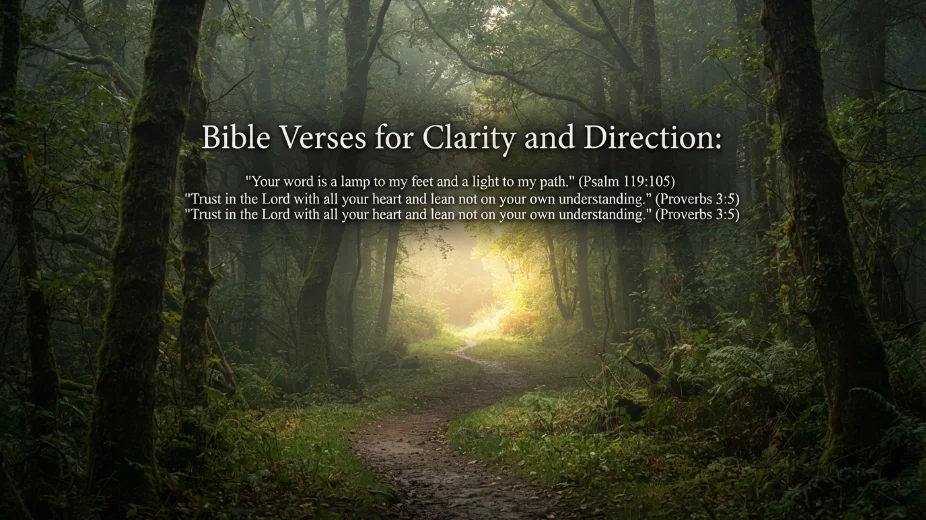
“Your word is a lamp to my feet and a light to my path.”
Context and Meaning: In the ancient world before electricity, a lamp didn’t illuminate the entire road ahead — it gave you just enough light for the next step. This metaphor is intentional. God rarely reveals the full roadmap all at once. He illuminates the next step, then the next. The psalmist’s point is that consistent immersion in Scripture is the practice that keeps the light burning.
Practical Application: If you are seeking direction and you haven’t been regularly reading your Bible, start there. Not because Bible reading earns guidance from God, but because the Bible is the primary way God communicates His character, His values, and His will — and clarity comes as we align our minds with His. Try reading one chapter of Proverbs each day for a month (there are 31 chapters — one for each day). You will be surprised how much wisdom God provides for everyday decisions.
Why It Still Matters: In an age of a thousand competing voices — social media influencers, podcasts, self-help gurus — the invitation to return to Scripture as your primary source of direction is more countercultural and more necessary than ever.
2 Timothy 3:16–17 — Scripture Equips for Every Decision
“All Scripture is God-breathed and is useful for teaching, rebuking, correcting and training in righteousness, so that the servant of God may be thoroughly equipped for every good work.”
Context and Meaning: The phrase “God-breathed” (Greek: theopneustos) is unique in the New Testament — it communicates that Scripture carries the very breath of God. Not just human wisdom, not merely historical records, but divine communication. The practical result of this inspiration is that Scripture equips believers for “every good work” — implying that no life situation falls outside the scope of what God’s Word can address.
Practical Application: When facing a specific decision, ask: what biblical principles apply here? You may not find a verse that addresses your exact situation, but you will find principles about integrity, wisdom, love, stewardship, and faithfulness that shed light on your circumstances. The Bible was never meant to be a lookup table for specific answers; it was meant to shape the kind of person who can discern God’s direction in any situation.
Category 4: Waiting for Clarity With Patience and Faith
Some of the hardest moments in the search for direction are not the moments of decision — they’re the long, ambiguous middle ground where clarity hasn’t arrived yet and patience is wearing thin.
Isaiah 40:31 — Renewed Strength for the Waiting Season
“But those who hope in the Lord will renew their strength. They will soar on wings like eagles; they will run and not grow weary, they will walk and not be faint.”
Context and Meaning: The Hebrew word for “hope” here — qavah — is also translated “wait.” It carries the image of a rope being twisted, gaining strength through the tension of waiting. Those who wait on God with expectant faith don’t grow weaker in the waiting; they grow stronger. The progression in this verse is also noteworthy: it moves from soaring to running to walking — suggesting that persevering faithfulness in ordinary, plodding obedience may be the greatest form of trust.
Practical Application: If you’ve been waiting for clarity for what feels like a very long time, don’t interpret the delay as divine disinterest. Waiting seasons are growth seasons. Ask God what He wants to develop in you during this time of not knowing — and trust that the clarity, when it comes, will arrive on time.
Psalm 37:23–24 — Steady Steps Even When You Can’t See the Whole Path
“The Lord makes firm the steps of the one who delights in him; though he may stumble, he will not fall, for the Lord upholds him with his hand.”
Context and Meaning: The word “firm” here (Hebrew: kun) means established, set in place, prepared. This is not the image of someone navigating perfectly — notice that the verse acknowledges stumbling. But the stumble doesn’t become a fall, because God is holding on. The condition for this promise is delight — not perfection, not a flawless record of right decisions, but a heart that genuinely loves and seeks God.
Practical Application: You are allowed to make imperfect decisions while seeking God. In fact, you will. The promise here is not that you’ll always choose perfectly — it’s that God is steady enough to hold you even when your steps aren’t. Take the next step with the information you have, trusting that God’s hand is underneath you.
Category 5: The Role of Peace in God’s Guidance
One of the most practically helpful — and often overlooked — aspects of biblical guidance is the role of inner peace as a spiritual compass.
Colossians 3:15 — Let Peace Be Your Umpire
“Let the peace of Christ rule in your hearts, since as members of one body you were called to peace. And be thankful.”
Context and Meaning: The word “rule” here is the Greek brabeuo — it means to umpire, to arbitrate, to decide. An umpire doesn’t play the game; they judge what’s in and what’s out. Paul is saying that the peace of Christ can function as a spiritual umpire in your decision-making. When you’re leaning toward a choice that consistently produces anxiety, dread, or a loss of peace — take notice. Conversely, when a direction consistently produces a settled, stable peace, even if it’s not the easiest option, that peace may be God’s guidance.
Practical Application: After praying about a decision, sit quietly and notice what happens in your heart. This is not the same as following your feelings — feelings can be unreliable and emotion-driven. The peace of Christ is different: it’s the “peace that surpasses understanding” described in Philippians 4:7 — a calm that doesn’t entirely make logical sense but is recognizably from God.
Philippians 4:6–7 — From Anxiety to Clarity Through Prayer
“Do not be anxious about anything, but in every situation, by prayer and petition, with thanksgiving, present your requests to God. And the peace of God, which transcends all understanding, will guard your hearts and your minds in Christ Jesus.”
Context and Meaning: This is one of the most practical passages in the New Testament on the relationship between prayer and peace. The sequence is important: present your requests to God with thanksgiving (not just desperation), and then receive the peace that surpasses human comprehension. Note that Paul doesn’t promise that praying will immediately produce the answer — he promises it will produce peace, which then creates the mental and emotional clarity to hear God’s guidance.
Practical Application: Anxiety is one of the primary enemies of spiritual clarity. When worry fills your mind, it becomes very difficult to hear anything quietly. The practice here is to convert anxiety into prayer — not just listing your needs, but bringing them to God with gratitude for who He is. Then watch for the peace that follows. That peace is not an end in itself; it’s the clearing of the fog that allows God’s direction to become visible.
Category 6: The Wisdom of Godly Counsel
The Bible consistently pairs seeking God’s guidance with seeking wise human counsel — the two are not in competition; they complement each other.
Proverbs 15:22 — Why Isolation Produces Bad Decisions
“Plans fail for lack of counsel, but with many advisers they succeed.”
Context and Meaning: Solomon — the wisest human being who ever lived — wrote this. The principle is universal: even the most intelligent, spiritually mature person benefits from outside perspective. The word “advisers” here implies multiple voices, not just one person who tells you what you want to hear. The diversity of perspective helps reveal blind spots that we inevitably carry in every significant decision.
Practical Application: If you’re seeking clarity on a major decision, identify two or three people who are spiritually mature, know you well, and will tell you the truth even when it’s uncomfortable. Bring your situation to them. Listen carefully. You don’t have to follow every piece of advice you receive, but taking counsel seriously is a biblical discipline that consistently produces better outcomes.
Proverbs 11:14 — Safety in Multiple Perspectives
“For lack of guidance a nation falls, but victory is won through many advisers.”
Practical Application: This principle scales from nations to individual lives. When you’re making a significant decision — a career change, a major financial commitment, a relationship choice — don’t try to figure it out entirely alone. The humility required to seek counsel is itself a spiritual discipline that opens you to God’s guidance through other people.
How to Practically Apply These Verses When You Need Direction
Understanding these scriptures is one thing; building them into a practical guidance-seeking framework is another. Here’s a step-by-step process rooted in the biblical principles we’ve explored:
Bring the Question to God First (James 1:5, Proverbs 3:5–6). Before consulting anyone else, take your decision to prayer. Write it out if that helps. Tell God exactly where you are — the confusion, the fear, the competing options. Ask specifically for wisdom. This positions your heart rightly before anything else happens.
Immerse in Scripture (Psalm 119:105, 2 Timothy 3:16–17). Spend time in the Word — not frantically searching for a “magic verse,” but reading consistently so that God’s principles become the natural framework through which you see every situation. Ask: what biblical values apply to this decision? What does God’s character say about this?
Seek Wise Counsel (Proverbs 15:22). Identify two or three mature believers who know you and who will give you honest, spiritually grounded perspective. Share your situation. Listen more than you speak. Notice where their counsel aligns or diverges from your own sense of God’s direction.
Notice the Peace (Colossians 3:15, Philippians 4:6–7). As you pray and wait, pay attention to your inner experience. Persistent anxiety about a particular option may be a signal. A quiet, settled peace toward another direction — especially one that feels countercultural or requires courage — may be God’s “go” signal.
Take a Step (Psalm 37:23–24). At some point, the goal is not perfect certainty — it’s faithful movement. God often guides us in motion more than in stillness. Take the next step with the clarity you have, and trust that God’s hand will steady you even if you stumble.
Step 6: Remain Flexible and Obedient (Isaiah 30:21). Once you’ve made a decision and begun moving forward, stay attentive. God may course-correct you along the way. His guidance doesn’t end once you’ve decided — He is continually leading, and remaining open to redirection is a mark of spiritual maturity.
A Prayer for Clarity and Direction
Father, I come to You in a season of uncertainty. The path ahead is not clear to me, and I confess that I have spent more time in worry than in worship — more time trying to figure things out on my own than surrendering to Your wisdom.
You are the God who led Israel through the wilderness with a pillar of cloud by day and fire by night. You are the Shepherd who leaves the ninety-nine to find the one who is lost. You are the Light that shines in every darkness. I need that guidance today.
I ask, as James promises I can, for wisdom — and I ask without doubting that You will give it generously, without reproach. Speak to me through Your Word. Confirm direction through wise counsel. Let Your peace be the umpire in my heart, ruling out what is not from You and settling what is.
Guard me from the paralysis of fear and the pride of self-sufficiency. Help me to trust You with the parts of this I cannot see. And when I take the next step — imperfect as it may be — steady me with Your hand.
I trust that You have plans for me — plans for a future and a hope. I rest in that today.
In Jesus’ name, Amen.
Frequently Asked Questions
1. What is the best Bible verse for guidance and direction?
Proverbs 3:5–6 is widely considered the foundational Bible verse for guidance: “Trust in the Lord with all your heart and lean not on your own understanding; in all your ways submit to him, and he will make your paths straight.” Other powerful verses include Psalm 32:8, James 1:5, and Isaiah 30:21. The “best” verse for your situation may be the one that speaks most directly to where you are — whether that’s fear, confusion, impatience, or the need for wisdom.
2. How does God give direction and guidance according to the Bible?
The Bible describes several primary means through which God guides His people: His written Word (Psalm 119:105), the Holy Spirit (John 16:13), wise and godly counsel (Proverbs 15:22), the peace of Christ in the heart (Colossians 3:15), and providential circumstances (Romans 8:28). Rarely does God use only one of these channels in isolation — discerning His direction often involves paying attention to how multiple streams of guidance align.
3. What does the Bible say about seeking clarity during confusion?
The Bible is remarkably honest about seasons of confusion and disorientation. Psalms like Psalm 25, 27, and 143 were written by David in moments of deep uncertainty. The consistent biblical response to confusion is: bring it to God in prayer (Philippians 4:6–7), seek wisdom through His Word (Psalm 119:105), ask God directly (James 1:5), and wait with active, expectant faith (Isaiah 40:31). The Bible never promises to eliminate confusion immediately — but it promises that God will guide those who seek Him.
4. How do I know if I’m hearing God’s voice or my own desires?
This is one of the most common and sincere questions believers ask. Several biblical tests help: Does the sense of direction align with Scripture? (God will never guide you toward something that contradicts His written Word.) Does it produce lasting peace or ongoing anxiety? (Colossians 3:15.) Does wise, mature counsel affirm it? (Proverbs 15:22.) Does it require you to grow in faith and character, or does it simply cater to comfort and ease? God’s guidance often involves stretching us — but it will always be consistent with His character of love, holiness, and wisdom.
5. What should I do when I pray for direction but don’t hear anything?
Silence in prayer doesn’t mean God is absent or indifferent. It may mean He’s asking you to wait (Isaiah 40:31), to search His Word more deeply (Psalm 119:105), or to act on what He’s already shown you (Psalm 37:23–24). Sometimes the silence is the answer — a call to be still and trust. Other times it’s an invitation to seek counsel or examine whether unconfessed sin or unresolved anxiety is blocking your ability to hear. Be patient, stay in Scripture, keep praying, and trust that God is never silent out of indifference.
6. Can the Bible give direction for specific life decisions like career or marriage?
The Bible rarely names your specific employer or future spouse. What it does is provide the principles, values, and character formation that enable wise decision-making. For a career decision, ask: Which option allows me to use the gifts God gave me? Which honors integrity and stewardship? Which serves others? For relationships, the Bible is clear about being equally yoked spiritually (2 Corinthians 6:14), about love’s characteristics (1 Corinthians 13), and about wisdom in choosing companions (Proverbs 13:20). Biblical guidance fills your decision-making framework, even when it doesn’t fill in every specific blank.
7. Is it a sin to be confused or unsure of God’s will?
Not at all. Confusion is a human experience, not a spiritual failure. Even the apostles, who walked physically with Jesus, were sometimes confused about His plans and purposes. The Bible never condemns sincere seekers who are wrestling with God’s direction. What the Bible addresses is trusting yourself over God (Proverbs 3:5–6) or refusing to seek His guidance at all. If you’re genuinely seeking God’s will with a humble heart, you are doing exactly what the Bible calls you to do — and confusion in that process is part of the journey, not evidence of failure.
8. How does faith relate to receiving clarity from God?
James 1:6–7 adds an important condition to the wisdom promise: ask “in faith, without doubting.” This doesn’t mean you must feel completely certain before God will guide you — faith is often most alive precisely in the presence of uncertainty. What it does mean is that you approach God’s guidance with a genuine openness to receive and obey whatever He shows you, rather than coming with a predetermined answer hoping He’ll rubber-stamp it. The faith that receives clarity is the faith that surrenders control.
9. What role does patience play in finding God’s direction?
Patience is not passive waiting — it’s active trust. Psalm 27:14 says, “Wait for the Lord; be strong and take heart and wait for the Lord.” The Hebrew concept of waiting (yachal) includes hope, expectation, and confident trust. Patience in the context of seeking direction means: you haven’t stopped praying, you’re still reading Scripture, you’re still listening, but you’re not trying to force an answer before God’s timing. Some of the most significant guidance in Scripture came after long seasons of waiting — Abraham, Joseph, Moses, David. The waiting was not wasted time; it was preparation.
10. What are some practical daily habits for staying in God’s direction?
Daily habits that keep you attuned to God’s guidance include: beginning each day with a short prayer of surrender and openness (“Lord, lead me today”), reading at least one chapter of Scripture every morning, journaling what you sense God saying through His Word, maintaining accountability with a spiritually mature friend or mentor, practicing gratitude throughout the day (which keeps your focus on God’s goodness rather than your circumstances), and ending each day by reviewing where you saw God’s hand and where you may have relied on your own strength. These habits don’t manufacture guidance — they cultivate the receptivity to recognize it.
Closing Encouragement:
If you’ve read this far, you’re probably someone who genuinely cares about walking in God’s will. And that very desire — that hunger to align your life with His purposes — is itself a gift He placed in you. The fact that you’re seeking is evidence that He is already at work.
Here is what the Bible affirms with unmistakable clarity: you serve a God who guides. Not a God who created you for a purpose and then left you to figure it out alone. Not a God who gives vague, cryptic clues and laughs when you miss them. A God who calls Himself your Shepherd, your Counselor, your Light, and your Way. A God who looked at the complexity of your life — every variable, every fear, every hope, every mistake you’ve made and every choice still ahead of you — and said: I will lead you.
You may not have the clarity you want today. The fog may not have lifted yet. But you are not wandering — you are being led by someone who knows every step of the path ahead, and who has promised to make it straight for those who trust Him.
Keep seeking. Keep praying. Keep reading His Word. And when the next step becomes clear — take it, even if it’s just one step, even if the step beyond that is still in shadow. That is what faith looks like. And that is the kind of faith God loves to honor.
“Your word is a lamp to my feet and a light to my path.” — Psalm 119:105
“I will instruct you and teach you in the way you should go; I will counsel you with my loving eye on you.” — Psalm 32:8
He sees you. He is leading you. Keep walking.
